Wednesday, December 04, 2019

End of an embodied era


December 3 marked what is in all likelihood the final time that I will teach ‘Embodied Cognitive Science’ (Psyco 457) at the University of Alberta. I’ve had substantial difficulty keeping the enrollment in that course up, and decided a few months ago to teach an introductory Cognitive Psychology course instead of it next year.
 
The course itself has a long history. It emerged from a (failed) attempt to establish some interdisciplinary cognitive science graduate courses in the late 1990s. (This explains why this course has always met in the evening – this was the only time that students from four different Departments had in common.) As graduate enrollment in that course (INT D 554) fell, it was double-numbered as an undergraduate course, and I began to introduce LEGO robots into its curriculum. It was then offered (perhaps in 2001) as PSYCO 403.
 
The course had some important developments over the past two decades. I received a McCalla Research Professorship in 2007 to integrate the course with my research. This led to the publication of a 2010 book on using LEGO robots to study embodied cognitive science. In 2013 the course received its current 457 designation.
 
Over the years there has been a fair number of students who have worked through the course, developing some very interesting robots and learning to write papers about embodied cognitive science. One interesting success story is my current graduate student Arturo Perez. Arturo stayed in Edmonton for a few months 7 years ago to learn about teaching cognitive science with robots, and transported those skills to Chile. One reason that he is back in Edmonton for graduate studies is because of his experience with this course.
 
The final edition of the course was very successful. Students developed a ‘functionally equivalent’ Grey Walter Tortoise over the term. The final class involved exploring the behavior of three of these machines as they interacted with their environment (and with each other). The images below reflect various stages of this project. The index cards scaffolded the students’ building, programming, and tweaking of their machine. The inventors of this machine pose with their work in the second photo. A still of robots in action is provided in the third photo. The last photois a fabulous time-lapse photo taken by Arturo illustrating robot behavior in a fashion very reminiscent of William Grey Walter’s own work.


Wednesday, August 29, 2018

Sabbatical Report: Project End


The goal of my past sabbatical was to conduct a project that studied how simple artificial neural networks learned about uncertain environments. This project was completed this past August 10 when I submitted a 240 page monograph for review at Comparative Cognition and Behavior Reviews. The sabbatical not only involved the actual writing this monograph, but also the collection of new results to be reported. This involved a tremendous amount of new research activity. I developed a number of new mathematical proofs about the relationship between simple artificial neural networks and Bayesian probability. I conducted hundreds of network simulations in order to collect data on how such networks behave in uncertain environments when interactions between cues serve as signals of reward probabilities. I also collected data from 200 Introductory Psychology students to measure their behavior in similar environments, and to compare human probability learning to that of my networks. There are striking similarities between network and human performance, and one of the main goals of my monograph is to use this relationship to support the claim that human probability learning can potentially be modeled by very simple artificial neural networks.

While this study of probabilistic artificial neural networks was the primary activity of my sabbatical, I have also been able to develop a new research project (in collaboration with Cor Baerveldt and his students in the Department of Psychology) on the history of the Center for Advanced Study of Theoretical Psychology at the University of Alberta. In particular, during we have explored archival materials and used our findings to explore the development of the Center’s flagship course ‘Seminar in Theoretical Psychology’ as well as the relationship of Center activities to Cold War social science. Both of these projects have led to manuscripts, one that is currently under review at History of the Human Sciences, the other soon to appear in History of Psychology. I also presented a poster at the 50th annual meeting of Cheiron on the contents of the books in the collection of the Center which are now included in the D.E. Smith Reading Room at the University of Alberta.

Sunday, December 31, 2017

Sabbatical Report: Last Day of 2017


With today marking the end of 2017, I thought I would provide an end-of-year update on my current sabbatical. I provided an update at the end of its first month on August 1, and have not provided much information since then. I have been too busy writing sabbatical projects to take the time to add to this blog!

The primary task for my sabbatical is working on a new book. This book explores the probabilistic behavior of simple artificial neural networks with a combination of citations to classic literature in information theory, probability theory, and cybernetics, with the reports of many formal proofs about network behavior, with detailed presentations of many new computer simulation results, and (eventually) with the report of the results of some new experiments on human probability matching.

The book is taking shape. Today – the last day of 2017 – marked the final tweaking of Chapters 4 and 5. So, the current status of the book is very solid drafts of its first five chapters, amounting to 145 pages that hold 73421 words. The next chapter requires me to scrape off the programming rust and write some new neural network code, which hopefully will not take too long. Once the new code is in place I will proceed with a new chapter on including positive feedback in a learning algorithm, which will then lead into a chapter in which I present the results of an experiment with human subjects that I conducted in September. I’ve been at the University of Alberta for 30 years, and this study marked the first time that I used the subject pool on my own!

The development of the book so far has involved collecting data from hundreds of different networks, not to mention reading a lot of new material. Since beginning this project I have consumed 33 books, and have to read several more to write a sensible version of Chapter 6.

The book project is the primary focus of my sabbatical. However, I have been very busy with another project as well. I have had the good luck to collaborate with my colleague Cor Baerveldt and his graduate students on the analysis of archival material related to the Center of Advanced Study in Theoretical Psychology, which existed at the University of Alberta from 1965 until 1990. We have been very busy with this project; we have two articles currently under review at different journals, and I have built a poster that goes with an abstract that I have submitted to Cheiron. With luck I will be able to present some new historical material when Cheiron holds its 50th annual meeting in June at Akron, Ohio, the home of a huge archive of psychological material.

In short, the sabbatical project is going well, and I am hoping that 2018 is a happy and productive new year – not just for me, but for anyone who has taken the time to read this post.

Happy New Year!

Sunday, September 17, 2017

Psychology at the Crossroads -- Again


I have a growing interest in studying the history of psychology, particularly the history of my own Department (Dawson, 2013). One of the surprising consequences of this work is that I sometimes find myself viewing current Departmental problems in a historical context.

 For example, one Departmental debate that arises every few months, and which has reached very high levels of administration, concerns what Faculty the Department of Psychology should be formally part of. We are in the almost unique position of having official status in both the Faculty of Arts and the Faculty of Science; this unique position has been the cause of considerable angst over the past year and a half.

 Interestingly, a little bit of history and reading indicates how this unique situation came to be. The Department of Psychology became an independent unit at the University of Alberta in 1960, splitting away from Philosophy. Its first Head was Joseph R. Royce; Royce was attracted to this position because the University of Alberta promised resources for his expensive research on behavior genetics (Royce, 1978). Royce was still Head when the Faculty of Arts and Science split into two separate faculties in 1963. In other words, it was Royce who was largely responsible for Psychology keeping a toehold in each faculty.

 Why did a behavior geneticist make this surprising administrative decision? Why did Royce not break away from Arts? Royce had a diverse and far-reaching vision of the discipline of psychology. For instance, he argued that it was a mistake to accept the general definition of psychology being ‘the science of behavior’. Instead, Royce believed that it was better to define psychology as ‘the study of behavior’. Replacing ‘science’ with ‘study’ opened the possibility for psychology to use a broader range of methodologies.

 Royce’s broad vision of the discipline was presented in a 1962 talk that became the opening chapter in his book Psychology and the symbol (Royce, 1965). Its title was “Psychology at the Crossroads between the Sciences and the Humanities”. For Royce, this crossroads was not a moment – unlike today -- of deciding to choose one direction or the other. Instead, the crossroads was an intersection, where psychology necessarily had to integrate the methods of both the sciences and the humanities. Royce recognized that psychology is “both scientific and humanistic, both experimental and clinical”.

 Given this position, it is hardly surprising that Royce’s also saw that it was necessary to attach the Department of Psychology to both the Faculty of Science and the Faculty of Arts. This remarkable decision arose naturally from Royce’s unique and broad vision. To me, it is clear that his goal was to offer the Department of Psychology the potential to explore broader, interdisciplinary initiatives than would be possible in a department with a more traditional organization.

 Recently, administrators seem to have lost sight of this possibility, focusing only on the complications that our unique structure produces. My own hope is that my Department is given an opportunity to stop viewing its current structure as problematic, and instead uses its advantages to become the kind of department that Royce imagined as its first Head. A Department that did so would be an exciting one to be a part of, and could bring some unique opportunities to the University at large.

 References 
Dawson, M.R.W. (2013). A case study in Gantt charts as historiophoty: A Century of Psychology at the University of Alberta. History of Psychology, 16(2), 145-157.
Royce, J.R. (1965). Psychology and the Symbol. New York: Random House.
Royce, J.R. (1978). The life style of a theory-oriented generalist in a time of empirical specialists. In T. S. Krawiec (Ed.), The Psychologists (pp. 222-259). New York: Oxford University Press.


Tuesday, August 01, 2017

Sabbatical Report: End of Month 1

Today marks the end of the first month of my current year-long sabbatical. I thought that this was as good a time as any to reflect on what I have accomplished so far, and to consider where my research is heading.

While the sabbatical is only officially one month old, the stage for the project was set in the fall term of 2016. In order to be fortunate enough to be awarded a sabbatical, one must apply for it, and part of this application involves proposing the kind of work that will be accomplished during the sabbatical. I have a long history of writing a book during each year-long sabbatical that I have been awarded; the plan for the current sabbatical was no different. I proposed using the time to draft a manuscript that extended some recent work in my lab on simple artificial neural networks and probability theory, and was lucky enough to be given the green light for this kind of project from the Faculty of Arts.

With a sabbatical plan required in the fall, it is not surprising that I was in a position to start groundwork for the current sabbatical at the end of the fall term. Much of that work has involved doing a lot of reading – since marking the final exam for my fall cognitive science course, I have read 23 books on systems theory, cybernetics, information theory, and probability. Those interested can see what I have been reading by looking through my Instagram account (https://www.instagram.com/drmrwdawson/) for pictures of covers. I use #reading to tag these posts. I have also conducted a pretty extensive simulation study (which has involved training and analyzing the performance of 500 different perceptrons) that explores how networks match the probability of outcomes in a three-cue probability learning task. In the fall, I plan to collect data from human subjects that are trained on the same task that I have used to train the networks; I am pretty excited about the main result that I expect to observe when networks and humans are compared. This has meant that I have also written programs to collect this data from humans. Importantly, I have also successfully navigated the process for getting ethics approval for this work; I haven’t collected human data for years. Most importantly, I have already crafted three complete chapters of a new book manuscript (when published, it will be my eighth book) that relate networks to probability theory and information theory, that explore the relationship between simple networks and Bayes’ theorem in probability, and that report the results of my simulations.

As August begins, the sabbatical project turns to writing the opening chapter of the new book. I have enough of a ‘feel’ for the project now that I need to put it in the context of other theories, and need to lay out its purpose, methodology, and implications. Writing this chapter, though, requires me to do a lot more reading than I have been doing. Up to this point, I have been reading a book every 10 days or so, and I have to accelerate this. In short, currently my next steps are to read, to think, and eventually to write. Some sense of the different topics that I will be considering will be appearing in the near future as Instagrammed book covers.

Monday, January 30, 2017

The Embodiment of Books

When thinking about books, we usually focus on their content, and not on their physical structure. However, the actual layout of a book is sometimes just as important as the meanings of the words one finds on its pages.

One notable example of this is the incredible novel House of Leaves (Danielewski, 2000). In many instances the pages of this book contains only a few words, arranged in peculiar ways to mirror events occurring in the novel. You haven’t experienced reading about a chase until you do so in this book, flipping rapidly to the next page during a pursuit, so that the frequency of moving to the next page reflects the increasing action unfolding in the plot.

A nice scholarly example of an interesting embodiment is The Society of Mind (Minsky, 1985). This book explores the idea of cognition emerging from the interactions of numerous simple agents. It is laid out in such a way that each chapter takes up a single page. This encourages the reader to interpret each chapter as a simple agent, and to consider interacting messages from chapters as delivering the rich message of the book. I was so taken by this sort of embodiment that I drafted two whole book manuscripts in this format (Dawson, 2008; Dawson, Dupuis, & Wilson, 2010). You start to write amazingly concisely when every page has to deliver a standalone message!

I’m thinking about books and embodiment because I’ve just finished reading one of the visionary books of embodied cognitive science, the influential The Tree of Knowledge (Maturana & Varela, 1998). This books provides a strong anti-representational view of cognition, arguing instead that cognition emerges from the linked relationships between self-organizing systems and the environments that they act upon. What is amazing about The Tree of Knowledge is that it is laid out as an introductory text, with a small single column of text on most pages, as well as numerous definition boxes and figures. In keeping with this format, the book is written in a disarmingly elementary style, even as it provides a complex and novel view of cognition that is quite distinct from typical perspectives. That is, the book is easy to read – but challenging to understand!

Maturana and Varela clearly had to work very hard to carry out this particular style of writing and of presenting ideas. The afterword indicates that the book itself was a decade in the making.

References

Danielewski, M. Z. (2000). House of leaves (2nd ed.). New York: Pantheon Books.
Dawson, M. R. W. (2008). Connectionism and classical conditioning. Comparative Cognition and Behavior Reviews, 3 (Monograph), 1-115.
Dawson, M. R. W., Dupuis, B., & Wilson, M. (2010). From Bricks To Brains: The Embodied Cognitive Science Of LEGO Robots. Edmonton, AB: Athabasca University Press.
Maturana, H. R., & Varela, F. J. (1998). The Tree of Knowledge. Boston, MA: Shambhala.
Minsky, M. L. (1985). The Society Of Mind. New York: Simon & Schuster.

Sunday, January 01, 2017

Science in the Service of Humanity


As part of an ongoing history project, I have been reading a great deal about general systems theory and about cybernetics. Much of this reading began with some of the major works of Ludvig von Bertalanffy (Problems of Life, General System Theory, Robots Men and Minds). It has also included some biographical works about von Bertalanffy, as well as of other scholars involved in systems thinking and cybernetics. I have also pulled from the shelves of my library some classic works by Norbert Weiner and Gregory Bateson and placed them on the front burner.

One of the striking characteristics of von Bertalanffy’s writing is his emphasis on human values. Von Bertalanffy spent his career reacting against mechanistic views in science, and proposing an organismic alternative. One of his great concerns was that the mechanistic view of nature and of man deemphasized humans as individuals, and viewed them instead as cogs in a great machine. From his perspective, this led to many of the dark social and political moments of the 20th century. One Bertalanffy was particularly critical of Weiner’s cybernetics for exactly this reason; he viewed cybernetics as turning men into robots and leading the society into peril by advancing military technology. In contrast, von Bertalanffy was one of the founders (along with Kenneth Boulding, Anatol Rapaport, and Ralph Gerard) of the Society for General Systems Research. They planted the seed for this society in 1955 at the Center for Advanced Study in Behavioral Science. SGSR’s initial slogan was “Science in service of humanity”.

In the context of this slogan, von Bertalanffy’s criticism of the Weiner’s mechanized cybernetics misses the mark. Weiner himself had deep concerns about cybernetics’ technological impact on society and expressed these concerns in many of his writings. Similar concerns are easily found in the writings of other cybernetic leaders such as Bateson and Margaret Mead; in general, the cybernetic pioneers were actively sympathetic with the notion of applying their scholarly ideas for the betterment of society.

What strikes me as I read the optimistic values and goals of these eminent researchers; as I see their deep concerns about the relationship between science and the good of mankind; as I reflect upon their explicit goal of improving humanity through their scientific ideas, is this: half a century later all of these concerns seem missing from much of modern science. Nowadays it seems that science is replaced these noble social concerns with goals of developing products or commodities, or with solving specific problems that have been identified by government agencies as requiring particular attention.


“Science in the service of humanity” strikes me as a particularly powerful notion, and on this first day of 2017 I resolve to explore its implementation in my own scholarly activities.

Friday, October 09, 2015

A 'Strange Circles' Ukulele Exercise

In my lab we train artificial neural networks to solve musical problems, and then examine the structures of these networks to see how they work.  Usually we do this to make discoveries about music theory and musical cognition.  However, sometimes we stumble onto something more practical – like new ideas for exploring chord progressions along the fretboard of a ukulele.

In an earlier project we trained a network to learn the Coltrane changes, which is an important progression of jazz chords.  Inside this network we discovered an interesting map, presented below, that leads from the root note of one chord to the root note of the next.

 The map above has one intriguing property: its outer and inner rings of notes are examples of what we call strange circles.  Each of these rings is a circle of major seconds; neighboring pitch classes on the ring are a major second, or two semitones, apart.  For instance, A is a major second away from both B and G (the outer ring), while D is a major second away from both C and E (the inner ring).

One day the map above happened to be drawn on the chalkboard when I was in the lab with my ukulele in hand.  I was noodling some minor chords, and was pleased by the sound of moving from D minor to A minor.  As I played these two chords, I looked at the map on the board, and noticed how it lined up these two notes.  Intrigued, I played other combinations of chords – for instance C minor and G minor – whose root notes were in similar relationships in the map.  They too were pleasing.  I then realized that a slight modified map would produce a new picture that I could use to guide me through a progression of twelve different chords.  I drew the map, played its succession of chords, and I really liked the sound of the entire progression.

I created this new map by rotating the inner ring of notes to a different position, so that D was aligned with A, C was aligned with G, and so on.  The new map that I created is given below:

The arrows on the map indicate how I use it to move from chord to chord.  Let’s say I start with a D chord.  The black arrow indicates that next an A chord will be played.  The grey arrow shows that I next move counterclockwise to the second pair of chord roots, beginning with the inner ring (playing a C chord) and then moving to the outer ring (playing a G chord).  I continue this pattern moving around the map, eventually returning to where I started, at the ‘D’ location of the inner ring.

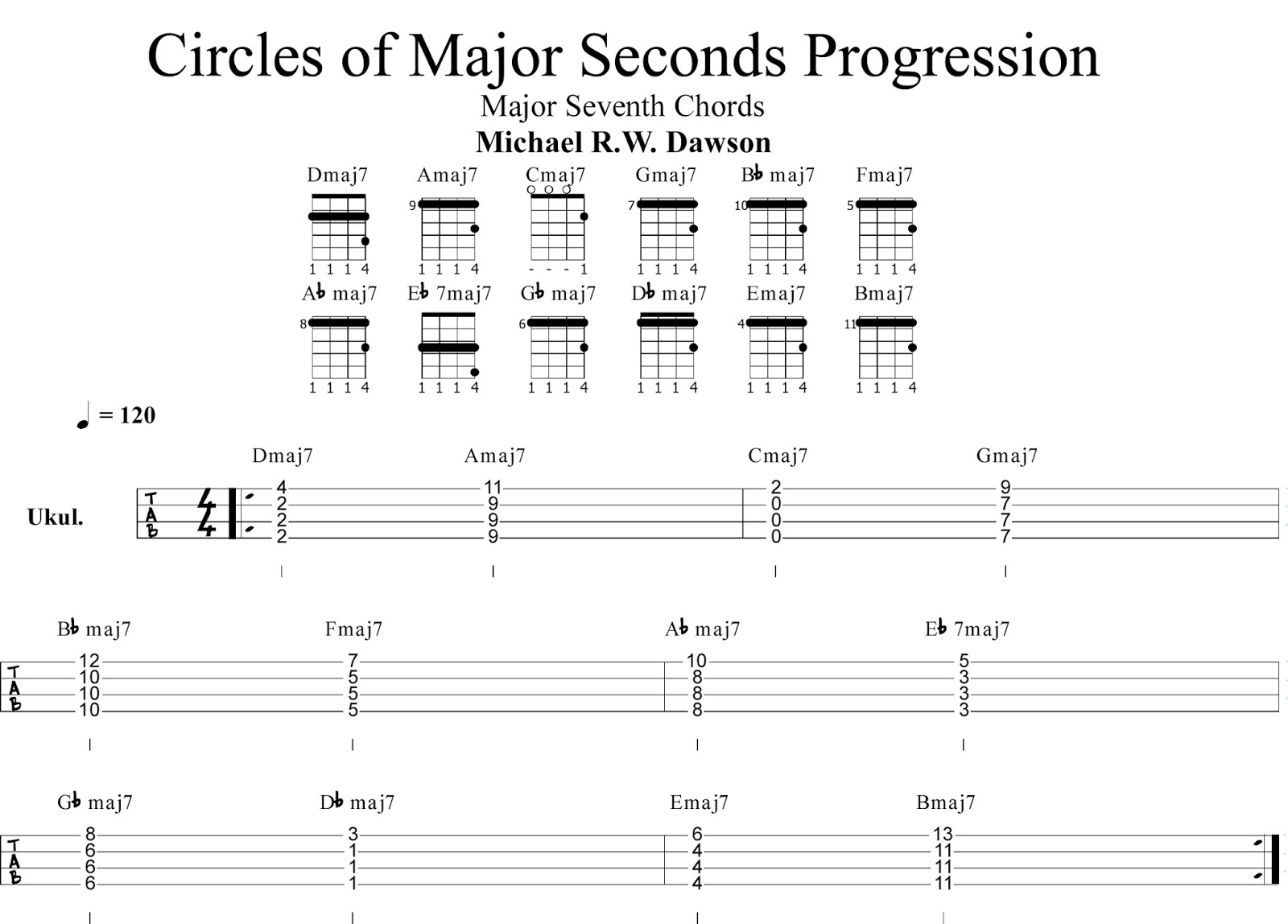
One example of following this pattern is provided in the score below.  This particular example plays major seventh chords at each map position, which has (to my ear at least) a pleasing, jazzy sound.  The score uses ‘closed form chords’, which involve pressing a finger down on each ukulele string.  So playing this score is an exercise in moving a closed form shape up and down the length of the fretboard.  The Cmaj7 chord is formed at the very top of the fretboard, while the Bmaj7 is formed with the index finger barred across the 11th fret near the fretboard’s bottom.  So, by following the new map one can perform a progression of chords that 1) uses each of the 12 possible roots in Western music, and 2) does so by covering the majority of the fretboard’s geometry.


The score above offers just a hint of the potential for using the map.  Simple variations of the score involve replacing the major seventh chords with some other closed forms, such as the minor seventh (or major sixth), the dominant seventh, or the major.  Of course, one could then use different chord types at different points in the score.

Another approach to varying the sound of the progression would be to follow a different route on the map – for instance going from the inner ring to the outer ring for the first pair of chords, but then going from the outer ring to the inner ring for the following pair of chords.

Another interesting approach would be to follow the same paths that are illustrated above, but to rotate the inner ring to a different position inside the outer one.  For example, one clockwise twist of the inner ring would line up the D with the B, the C with the A, and so on.  Changing the position of the inner ring would change the musical distance between successive chords, and as a result change the musicality of the progression.

Wednesday, July 01, 2015

History, Psychology, and Poster Philosophy

In a few days my wife and I head to Angers, France to participate in the meeting of the European Society for the History of the Human Sciences (ESHHS).  She is one of the speakers in a symposium about the recent controversy concerning the identity of Watson’s ‘Little Albert’, while I am presenting a poster that uses Gantt charts to explore the history of the Department of Psychology at the University of Alberta.

I do not participate in many conferences, but these days when I go to a conference I like to present a poster instead of a talk.  The reason: I prefer to have conversations about research; posters facilitate this while talks do not.  But how does one maximize the ability of a poster to initiate conversations?

My answer to this question is to design posters that have as few words as possible – a poster that is almost exclusively a collection of images.  Minimizing the number of words on a poster reduces the likelihood that someone will simply come up to the poster, read it, and move on without talking.  Remove the poster’s words; you force your audience to ask you what the poster is about – which starts a conversation.

My ESHHS contribution, ‘Using Gantt Charts To Explore The History Of A Canadian Psychology Department’, is one that fully reflects my poster philosophy.  It consists of 14 graphs; the only text on the poster is its title and the various graph labels.  Most of the graphs are Gantt charts like the one described in this previous post.  Two of these Gantt charts are gigantic – they provide the timelines for each faculty member, or for each course offering, throughout over a century of the Department’s history – and all of the others are derived from these two major plots.  It is more of an art piece than a typical scientific presentation.  I really like the look of it, I think that it is my most striking poster ever.

If you are interested, an 11 mb version of the whole poster can be viewed as this PDF file.

I like several things about this poster, which has been ‘test driven’ over the last couple of weeks near the main office of my Department.  First, as you get closer and closer to it, you realize that it contains a lot of information.  It really draws you in.  Second, the graphs are unfamiliar – Gantt charts are not typically seen in this field.  As a result, the poster demands questions, such as 'What do these graphs show?'.  On July 7 I will find out how many questions it draws out!


Saturday, June 13, 2015

University of Alberta Cognition: Late – and Early!


Over the last couple of weeks I have visited the University of Alberta Archives to pore over their copies of past Calendars.  As part of a history project that I am presenting at the European Society for the History of the Human Sciences (ESHHS) next month I have compiled the course offering for Psychology from 1909 to 2015.  This list is composed of 5089 separate entries, which might explain why my eyes are tired and my typing fingers are aching.

The point of collecting this data is to illustrate it (and later analyze it) using Gantt charts; a previous project took this approach to illustrate the various faculty members who have belonged to the Department in its existence for more than a century.  The previous project was pretty laborious; this time around I have been able to automate a lot of it using Excel (and VBA) to organize the data to provide to R (and the Plotrix package) for plotting as a Gantt chart.

This approach can be used to provide some interesting insights into Departmental course offerings.  For instance, the figure below provides the Gantt chart of just those courses related to modern cognitivism:


 Examining the Gantt chart above indicates that cognitivism arrived at the University of Alberta in the late 1960s.  The first offering, “Topics in Cognition”, appeared in the Calendar for 1968-69.  The Department’s first hiring of an ‘official’ cognitive psychologist was in 1979 when they recruited Alinda Friedman, who has just retired after becoming the longest serving female faculty member in Department history.  Given that cognitivism arose in the mid to late 1950s, it seems that University of Alberta was a pretty late entrant into the cognitivist movement!

Interestingly, though, this story is incomplete.  One of the earlier courses offered by the Department was ‘Legal Psychology (Psychology 56)’, which appeared in the 1922-23 Calendar, and was last offered in 1939-40.  When it first appeared in the Calendar it was described as a course about “normal and abnormal mental processes in relation to problems of judicial procedure”, and explored topics like motivation of crime, the discovery of guilt, mental deficiency and insanity, and individualization of punishment.  This Calendar description was pretty much unchanged from the creation of this course through the 1930-31 Calendar.

However, the Calendar description of Legal Psychology changed markedly in the 1931-32 Calendar, as the image below demonstrates.  The description is split into two parts, with the second one being very similar to the older entries.  However, the new first part is explicitly cognitive in nature: it includes the phrase “cognitive processes”, and focuses on perception, memory, and problems arising in both of these subtopics.


 Two things interest me about this new description of Legal Psychology.  The first is that it demonstrates a very early arrival of cognitivism at the University of Alberta.  This course description is about a quarter of a century earlier than the cognitive revolution!  The second is that I cannot determine any reason for this particular change.  For instance, there were no new faculty members in the Department whose arrival would have led to such a change.

In short, modern cognitivism arose late at the University of Alberta, although the Gantt chart provided above indicates that it is still healthy.  It was preceded, however, by a course in Legal Psychology that was over a quarter of a century ahead of its time.


Wednesday, June 03, 2015

On Books and BS

This blog isn’t about the usual BS that my students might associate with my books – instead it is about the kind that affects my book production: blood sugar.

I have been coping with Type II diabetes since the turn of the millennium, and my control of my blood sugar levels has been sketchy at times.  When I was first diagnosed I became well-versed in typical diabetes-related problems (kidney trouble, heart trouble, eye trouble, infections and amputations).  However, during one period in which my blood sugar was out of control I discovered another issue while reading the literature at my specialist’s office.  Apparently there are a host of cognitive deficits that can occur with high blood sugar levels too.

More recently I encountered this problem first hand.  During the fall of 2013 and the winter of 2014 I was having a great deal of trouble concentrating.  I was working with an undergraduate student on an artificial neural networks and music project that required interpreting the internal structure of trained networks.  I was having a lot of difficulty making any sense of any of these networks.

Not coincidentally – although I did not realize this until later – my blood sugar had entered a phase that required stronger control.  At that time I used oral medications and an evening injection of slow acting insulin.  A visit to my specialist resulted in a new regime of pre-meal injections of fast acting insulin.  I started this treatment in the first week of April 2014.

What astonished me is that within a week it seemed as if my brain suddenly turned on.  I found that my ability to concentrate was stronger and my thinking was clearer.  On April 9, 2014 I took a look at the connection weights of a simple network that was resisting analysis, and immediately saw how the network worked.  I couldn’t believe it.  I started writing the interpretation up on April 11, in what became the first chapter of a new book.  For about a year up to that point I had a lot of difficulty writing.  After starting the new insulin regime I was working and writing daily, and a week ago submitted a new book manuscript comprised of over 300 pages, 150 figures, 50 tables, and a whole bunch of new simulation results and network interpretations.  I don’t think that this would have happened without the change in my treatment.

Of course this evidence is totally anecdotal, but I now have a lot more respect for how my blood sugar control can affect what I’m paid to do (i.e. think).  I’ll apologize in advance to my students, who will likely find more of that other BS in my new book when it comes out! I have one kind of BS under control, but have never figured out how to control the other
 

Monday, May 25, 2015

Coda: Our New Music

As described in this previous post, the  text below is a draft of one of several "interludes" to be included in a book that I am working on concerned with music and artificial neural networks.  This particular post is the Coda for the book; the interlude that comes at the end of the main text.
 

Figure C-1. Four key notes for the song “How Dry I Am” used by Bernstein to illustrate the infinite variety of music.
 
The tonality of Western music arises from its exclusive use of twelve pitch-classes.  In spite of being constrained by this sparse set of basic musical elements, composer Leonard Bernstein argues that Western music is infinite in its variety (Bernstein, 1966).  He observes that if one considers the twelve pitch-classes in a single range, and computes their possible melodic combinations, the result is 1,302,061,344.  If one extends this approach to consider both melodic and harmonic combinations of these elements the result is 127 googols, where a googol is a digit followed by 100 zeroes.  “The realm of music is an infinity into which the composer’s mind goes wandering” (Bernstein, 1966, p. 34).

Bernstein (1966) explores this theme with a particular example, the four note melody that starts the song “How Dry I Am”.  These four notes are provided in Figure C-1.  He notes the importance of this pattern, and the variations of musical effects that it can produce, by noting its presence in a huge range of compositions that begins with a French folk song and ends with the final movement of Shostakovich’s Fifth Symphony.  Bernstein ends his discussion by proposing a variation of Figure C-1 that depicts “a motto of man’s infinite variety” (Bernstein, 1966, pp. 46-47).

Early in this book we saw another example of variety from small numbers of elements.  The musical signal composed by John Williams for Steven Spielberg’s 1977 movie Close Encounters of the Third Kind (Figure O-1) was selected from a sample of 350 five-note compositions created by Williams.  Had Williams composed all possible five-note melodies the movie’s signal would have been selected from among about 134,000 possibilities.  The calculation of possibilities is conservative because it fails to take into account rhythmic variations; not all of the notes in Williams’ signal have the same duration.

The infinite possibilities of Western tonal music are reflected in music’s constant evolution.  American composer Aaron Copland wrote Our New Music (Copland, 1941) to explain the circumstances that had led to modern classical music.  His goal was to alleviate his readers’ bewilderment with modern music.  “Being unaware of the separate steps that brought about these revolutionary changes, they are naturally at a loss to understand the end result” (Copland, 1941, p. v).  He traced modern music’s development as a move away from a century of Germanic musical influences.  This move begins with explorations of folk music in the late 19th century, proceeds through explorations of new views of harmony, rhythm, and tonality.  Copland argues that it ends by coming full circle, in Stravinsky’s compositions of the late 1920s and early 1930s, and returning to melodic forms from the 18th century.

The infinite possibilities of Western tonal music make it nearly impossible to predict its future too.  In the early 1940s one could analyze existing modern music and describe a neoclassicism that had roots in the 18th century (Copland, 1941).  However, Copland’s analysis of modern American music does not even hint of the radical developments that would flourish there beginning in the 1960s with, for example, the invention of mimimalism (Glass, 1987; Griffiths, 1994, 1995; Hartog, 1957; Nyman, 1999; Pleasants, 1955; Potter, 2000; Reich, 1974, 2002).

Western tonal music has infinite variety and unpredictability.  However, it is neither accidental nor unsystematic.  When a composer’s mind goes wandering into the infinite musical realm, it does not randomly move from one musical entity to another.  Its search through this realm is guided by new ideas concerning musical structure – new notions of melody, harmony, rhythm and the like – in short, new music theory.  Rather than being “dusty abstract rules of form and harmonic structure” (Bernstein, 1966, p. 24), music theory itself seems both vast and dynamic.  When violent upheaval is heard in classical music, its root cause must be changing conceptions of music’s structure.

Does musical theory itself exhibit infinite variety?  I have no idea.  However, historical examinations reveal enormous changes in basic ideas, such as whether different inversions of a chord are the same chord, or what is the root note of a major or minor triad (Damschroder, 2008; Rehding, 2003; Riemann, 1895).  We saw in Chapter 1 that the psychophysical study of music that began in the late 19th century faced the tension between the physics of sound and individual differences in aesthetics that permitted just intonation to be replaced by equal temperament (Hui, 2013).

As well, evolving notions of consonance have permitted new musical intervals to become accepted in music.  The dissonance of the flattened seventh note led Helmholtz to reject its use in his advice to composers (Helmholtz & Ellis, 1863/1954); now it is definitive to the blues and plays a central role in Gershwin’s classic Rhapsody In Blue (Adams, 2008).  Later, seasoned jazz musicians who were completely comfortable with the flattened seventh were jarred and puzzled by the flattened fifth interval when it was introduced to jazz via bebop (Kelley, 2009).

Clearly there is no single, unified theory of music.  A multitude of music theories have existed; many different theories can exist at the same time; new theories can be invented or discovered.  One approach to composing innovative music involves taking a new musical theory an examining the compositions that it can pick out of the infinite realm of music.  Where might one find a new musical theory to exploit in this fashion?

There are many, many possible answers to this question.  One reading of the current book suggests one: train an artificial neural network to map some musical inputs to some other musical outputs.  The kind of training that we have seen in preceding chapters informs networks about their progress, but does not inform them how to construct the mapping.  As a result, these networks can discover new musical regularities or ideas for performing the mapping.  We have seen many instances of this in the current book, even when networks are trained on basic, traditional musical tasks.

Crucially, for a network to deliver a new musical theory its internal structure must be explored.  Artificial neural networks can only inform the study of music if we first reject the romanticism that characterizes much of connectionist cognitive science.

 
References