Showing posts with label ukulele. Show all posts

Friday, October 09, 2015

A 'Strange Circles' Ukulele Exercise

In my lab we train artificial neural networks to solve musical problems, and then examine the structures of these networks to see how they work.  Usually we do this to make discoveries about music theory and musical cognition.  However, sometimes we stumble onto something more practical – like new ideas for exploring chord progressions along the fretboard of a ukulele.

In an earlier project we trained a network to learn the Coltrane changes, which is an important progression of jazz chords.  Inside this network we discovered an interesting map, presented below, that leads from the root note of one chord to the root note of the next.

 The map above has one intriguing property: its outer and inner rings of notes are examples of what we call strange circles.  Each of these rings is a circle of major seconds; neighboring pitch classes on the ring are a major second, or two semitones, apart.  For instance, A is a major second away from both B and G (the outer ring), while D is a major second away from both C and E (the inner ring).

One day the map above happened to be drawn on the chalkboard when I was in the lab with my ukulele in hand.  I was noodling some minor chords, and was pleased by the sound of moving from D minor to A minor.  As I played these two chords, I looked at the map on the board, and noticed how it lined up these two notes.  Intrigued, I played other combinations of chords – for instance C minor and G minor – whose root notes were in similar relationships in the map.  They too were pleasing.  I then realized that a slight modified map would produce a new picture that I could use to guide me through a progression of twelve different chords.  I drew the map, played its succession of chords, and I really liked the sound of the entire progression.

I created this new map by rotating the inner ring of notes to a different position, so that D was aligned with A, C was aligned with G, and so on.  The new map that I created is given below:

The arrows on the map indicate how I use it to move from chord to chord.  Let’s say I start with a D chord.  The black arrow indicates that next an A chord will be played.  The grey arrow shows that I next move counterclockwise to the second pair of chord roots, beginning with the inner ring (playing a C chord) and then moving to the outer ring (playing a G chord).  I continue this pattern moving around the map, eventually returning to where I started, at the ‘D’ location of the inner ring.

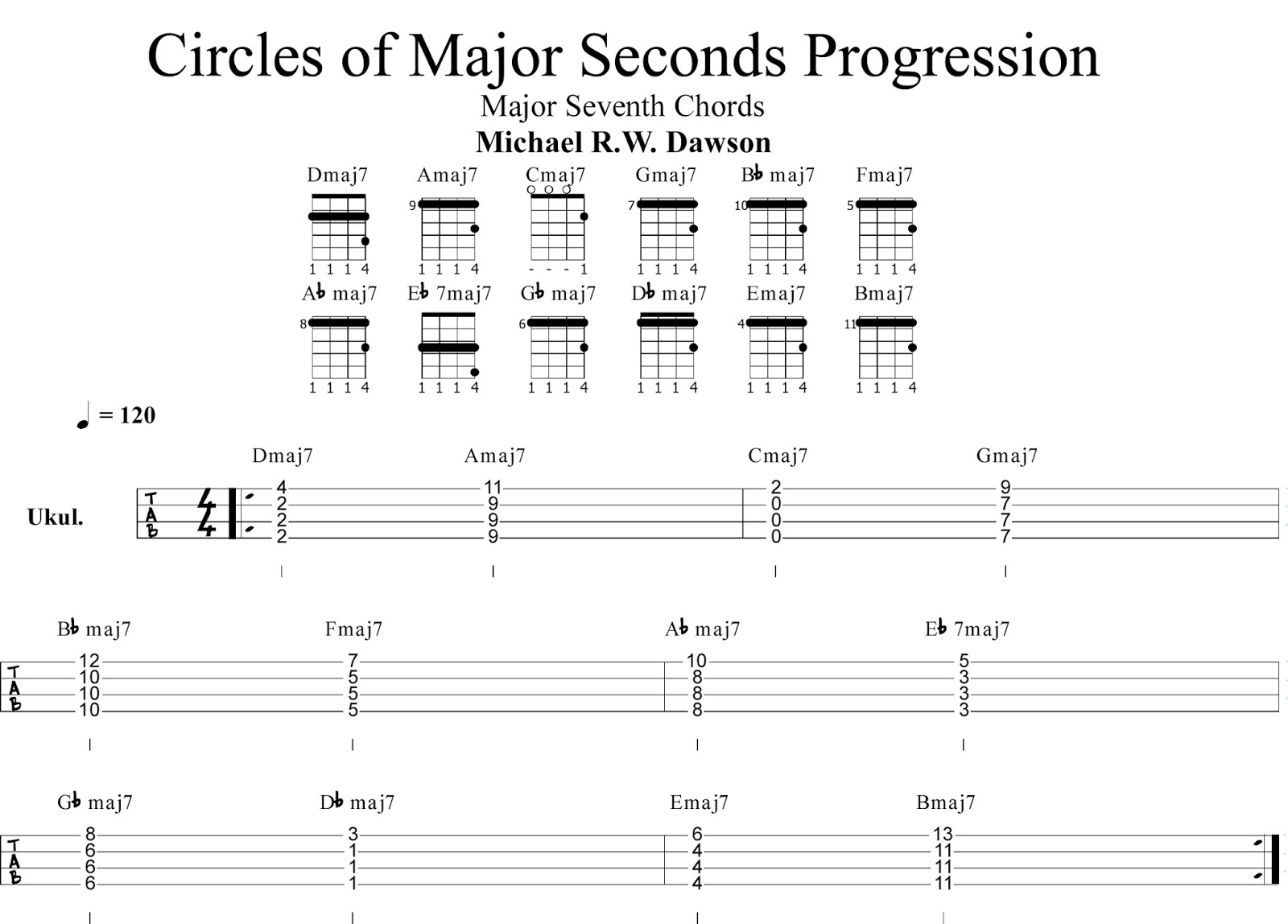
One example of following this pattern is provided in the score below.  This particular example plays major seventh chords at each map position, which has (to my ear at least) a pleasing, jazzy sound.  The score uses ‘closed form chords’, which involve pressing a finger down on each ukulele string.  So playing this score is an exercise in moving a closed form shape up and down the length of the fretboard.  The Cmaj7 chord is formed at the very top of the fretboard, while the Bmaj7 is formed with the index finger barred across the 11th fret near the fretboard’s bottom.  So, by following the new map one can perform a progression of chords that 1) uses each of the 12 possible roots in Western music, and 2) does so by covering the majority of the fretboard’s geometry.


The score above offers just a hint of the potential for using the map.  Simple variations of the score involve replacing the major seventh chords with some other closed forms, such as the minor seventh (or major sixth), the dominant seventh, or the major.  Of course, one could then use different chord types at different points in the score.

Another approach to varying the sound of the progression would be to follow a different route on the map – for instance going from the inner ring to the outer ring for the first pair of chords, but then going from the outer ring to the inner ring for the following pair of chords.

Another interesting approach would be to follow the same paths that are illustrated above, but to rotate the inner ring to a different position inside the outer one.  For example, one clockwise twist of the inner ring would line up the D with the B, the C with the A, and so on.  Changing the position of the inner ring would change the musical distance between successive chords, and as a result change the musicality of the progression.

Saturday, May 16, 2015

Coltrane Changes on the Ukulele

As described in this previous post, the  text below is a draft of one of several "interludes" to be included in a book that I am working on concerned with music and artificial neural networks.


Figure I-14. The most basic ukulele chords for the ii-V-I progression in the key of C major.  See text for details.
 
When investigating musical problems with artificial neural networks, I find it useful to hear the stimuli on a musical instrument.  While I have spent a lot time working out stimulus patterns on the keyboard of my piano, these days my instrument of choice is the ukulele.  In this interlude I will provide the chords that I use to play the Coltrane changes in the key of C major, developing this chord structure from variations of the ii-V-I progression.
 
Figure I-14 provides the three chords that define the simplest version of the ii-V-I progression on the ukulele.  Each chord diagram illustrates the four strings of the ukulele, and the dots on the diagram indicate the fret at which each particular string is depressed.  The three chords that are presented are based on the assumption that the progression involves a sequence of three triads (D minor, G major, and C major).  That is, if one creates these three triads using only the notes available in the C major scale, then one of these chords is necessarily minor, while the other two are major (see the discussion of Figure 7-15).
 
The ii-V-I progression is a staple in jazz, and using triads doesn’t provide the jazziest sound.  Jazz musicians are more likely to extend the triads used to create the Figure I-14 chords to create tetrachords.  This extension, which involves adding an additional note to each chord from the C major scale, was also illustrated earlier in Figure 7-15.  Figure I-15 illustrates how one would play the C major tetrachords for the ii-V-I on the ukulele.  Note that the D minor has now become a D minor seventh, the G major has become a G dominant seventh, and the C major has become a C major seventh.
 
Figure I-15. The ukulele tetrachords for the ii-V-I progression in the key of C major.  See text for details.
 
All of the chords illustrated in Figures I-14 and I-15 are called open position chords.  This is because at least one ukulele string in the chord is open; that is, it is not pressed down by a finger.  The advantage of open position chords is that they generally are easier to play.  The disadvantage of such chords is that they are special in the sense that they cannot be moved up or down along the ukulele fret board to play the same type of chord in a different key.  This makes these chords different from the closed form chords that were the topic of the previous interlude “Ukulele Chords and Perceptrons”.  Our next move is to transform the Figure I-15 progression into one that uses closed position chords.
 
In order to perform this transformation, we will use two different tricks.  The first is to replace the Dm7 and Cmaj7 chords with alternative fingerings that can be found in a decent ukulele chord book (Johnson, 2005).  For these two chords we pick two fingerings that are related; both are barre chords that involve pressing the index finger down across all the strings at the fifth fret.
 
The second trick is to take advantage of chord substitution.  In general, jazz musicians see a chord’s name as an indicator of potential chords.  For instance, when such a musician sees that a G7 is the next chord, they would feel perfectly comfortable with substituting a different, but related, chord.  Chord substitution conventions permit G7 to be replaced, for example, with G9 or with G13 in order to add musical variety.  We will choose the G9 chord because the barre form of this chord places it in a similar position on the fret board to the other closed form chords in the ii-V-I, as is illustrated in Figure I-16.
 
Figure I-16. Closed form ukulele chords for the ii-V-I progression in the key of C major.  See text for details.
 
There are three important points to make about Figure I-16.  First, the particular chord choices that it illustrates begin quite a bit further down the fret board (at either fret 5 or 4) than was the case in Figures I-14 or I-16.  Each chord diagram has a number on the left indicating the starting fret, and the chord diagrams have been extended more than is typical to show where on the ukulele each chord is being played.
 
Second, the G9 chord that is illustrated is not likely to be found in many ukulele chord dictionaries.  This is because this form of the chord does not include the root note G.  Instead, it uses the other four pitches that are part of G9.  These four pitches actually define a minor seventh (flat fifth) chord in a different key.  G9 as illustrated in Figure I-16 is also Bm7♭5.
 
Third, because these three chords are all in closed form one can move these patterns up or down the fret board to play the ii-V-I progression in a different key.  For instance if one uses the same chord patterns illustrated in Figure I-16, but moves each upwards a fret (towards the top of the page), then the result is the ii-V-I progression in the key of B major.
 
As detailed in Chapter 9, the Coltrane changes elaborate the ii-V-I progression by using the same three chords in Figure I-16, but also adds four additional chords that serve as lead ins.  We can create the Coltrane changes by adding these four chords to Figure I-16, attempting to choose closed form chords that minimize movements along the fret board.
 
The Coltrane changes for the ukulele in key of C major are presented in Figure I-17.  Each chord is a barre chord, meaning that this figure defines chord patterns that can be shifted to different fret board positions to generate the Coltrane changes in a different key.  For example, shifting each chord a fret downwards (towards the bottom of the page) produces this progression in the key of C# major.
 
 
Figure I-17.  Closed form ukulele chords for the Coltrane changes in the key of C major.
 
Creating the chord patterns in Figure I-17 serves the primary purpose of permitting me to play the Coltrane changes on the ukulele.  However, this set of chord diagrams suggests other uses.  One of the themes in Chapter 9 was exploring different encodings of jazz progressions for networks.  One could imagine adapting the encoding developed in the interlude that preceded Chapter 9 to present the jazz progressions to networks as sequences of ukulele chords.  What effect might this representation have on network complexity?

Similarly, Figure I-17 raises the possibility of generating alternative versions of the Coltrane changes for ukulele.  For instance, might easier chord fingerings emerge if one explores chord substitutions for the other dominant seventh chords in the figure?
 
References


Friday, May 08, 2015

Ukulele Chords and Perceptrons

As described in this previous post, the  text below is a draft of one of several "interludes" to be included in a book that I am working on concerned with music and artificial neural networks.
 

Figure I-10. Four examples of four closed form or moveable shapes that define major chords for the ukulele.  See text for details.
 

Many Diagrams for One Chord

 
In music theory a tetrachord is merely a chord comprised of four different pitch-classes.  From other perspectives, however, the notion of a tetrachord becomes more practical, and possibly more complicated.
 
One such practical perspective is provided by the ukulele, which is a small, four-stringed, guitar-like instrument typically tuned to the notes G4, C4, E4 and A4.  Any chord strummed on the ukulele is a tetrachord because it is produced by vibrating these four strings.
 
Learning to play the ukulele involves studying the finger positions that define various chords.  These positions are provided in charts or books filled with chord diagrams like the examples provided in Figure I-10.  In a chord diagram, the horizontal lines indicate the positions of the frets on a ukulele’s fret board, and the vertical lines represent the instrument’s four strings.  The black dots in a chord diagram indicate where, on the fret board, a finger should be pressed on the string to produce a pitch that is part of the desired chord.
 
The interacting physical structures of the ukulele and the human hand place constraints on the note combinations that constitute playable ukulele chords.    It is impossible to play every conceivable tetrachord on the ukulele.  A chord that involves placing the index finger on the first fret of one string, and the little finger on the 12th fret of a different string, is a practical impossibility.  In other words, in a playable ukulele chord one’s fingers are not too far apart.
 
The notes played on different ukulele strings are not too far apart either.  In terms of tuning, the furthest distance is between the C and the A strings, but this distance is only a major sixth (9 semitones).  The G and the A strings only differ by a major second (2 semitones).
 
The relative nearness of fingers in a playable chord, and the relative nearness of the tunings of ukulele strings, means that relatively minor changes in finger positions can produce the same chord.  This is because the changes in finger positions invert the chord’s notes.  That is, different fingering positions can produce the same component pitches of a chord, but on different strings.
 
The upshot of this is that there is a many-to-one relationship between fingering patterns and chords.  More than one chord diagram can represent the same ukulele chord.  For example, one of the modern bibles of ukulele chords (Johnson, 2005) provides three different fingerings for each of the 28 chords that it describes for each musical key, producing a book that consists of 1008 different chord diagrams.
 

Chord Shapes

 
How does a budding ukulele player even hope to learn such an incredible diversity of possible chords?  Thankfully there are some fingering patterns that can be moved up and down the fret board.  These are called closed form chords because their shape is defined by placing a finger on each of the ukulele’s four strings.  Four examples of such chords are provided in Figure I-10: these are all closed form chords because each chord diagram contains four fingering dots.
 
When a closed form chord is moved up or down the fret board, it causes the same type of chord to be played, but in a different key.  All of the closed form chord shapes in Figure I-10, for example, create a major chord no matter where they are formed on the fret board.  If one is formed at one location, it produces the B@ major chord.  The same fingering shifted to a different position produces the C major chord.
 
Closed form chords are efficient for learning the ukulele because once one learns a fingering pattern (e.g. any of the four patterns in Figure I-10), one has really learned 12 different chords.  All the player has to do is learn the name of the chord produced (e.g. B@ major, C major) at each location that the same fingering pattern is used.
 
Of course not all ukulele chords are closed form.  Some are special cases of closed form chords where the ukulele’s nut (the top of the fret board where the strings end) takes the place of fingers on some of the strings.  The four chord diagrams in Figure I-11 provide examples of such special cases.  These chords are typically learned first, are learned with different fingerings than the patterns in Figure I-10, and are only later related to the more general notion of closed form chords.  Still other chord forms are standalone patterns that cannot be moved along the fret board.  As a result, even learning one kind of chord, such as a major chord, requires acquiring a number of different chord diagrams.
 
Nevertheless, focusing on the shapes of the chord diagram – the relative positions of fingers on each string – provides efficiency.  The Hal Leonard Ukulele Chord Finder (Johnson, 2005) provides at total of 36 different chord diagrams for the major chords in each musical key.  However, from a player’s perspective, these 36 diagrams can be condensed into only 13 different chord shapes.


Figure I-11. Four special case major chord shapes.  The top fret of each of these chord diagrams is the first fret of a ukulele; the wide horizontal black line in each diagram is the ukulele’s nut.  Each of these shapes is a special instance of each of the four general chord shapes in Figure I-10.  See text for details.
 

Towards Reverse Chord Finding


Chord dictionaries are organized alphabetically by the root of the chord, and then by chord type.  If you need to find out how to play a particular chord, then you can quickly look it up by using its name.

Learning to play the ukulele is, thankfully, more than just poring through the pages of chord dictionaries.  A player can explore different fingerings without knowing the name of the chords being played.  On finding one such chord that has a particularly pleasing sound, there may be keen interest in finding out the chord’s name.  However, chord dictionaries are not organized by fingering patterns.  This problem – known as reverse chord lookup – does not have an easy book solution.

The reverse chord lookup problem, though, is very similar to problems of identifying scale roots, of identifying scale modes, and of keyfinding that have appeared earlier in this book.  In those earlier problems, a set of notes was presented to a network, and the network output some judgment about the input – a root note, a scale mode, or both.  Is it possible to create a network that can provide the names of chords when provided their fingering?

One complication that presents itself when considering this possibility is the many-to-one relationship between chord diagrams and chords.  In our previous encounters with scale roots and modes, the relationship between input and output was one-to-one.  Can networks adapt to the complexities of many-to-one relationships?

I decided to explore this particular question before facing the larger reverse chord lookup problem.  I trained a network to decide whether a chord was major or minor when presented the chord’s diagram.  This is an interesting test case because, as we have seen, there are many different chord diagrams that are each associated with a major chord.  Furthermore, there is a great deal of similarity between the shapes of major and minor chord diagrams because one can change a major chord into a minor chord by moving only one finger.  Detecting major chords is a challenging problem.

Major chord detection is also an interesting problem with respect to network interpretation.  As discussed above, ukulele players learn chords by paying attention to the shapes of their chord diagrams.  Such shape information is not likely to be directly available to a network whose only window onto a chord diagram is a set of input units.  If a network can detect major chord patterns, then how does it represent their structure?

The first problem to deal with in developing this network is representing input patterns.  I decided to represent each chord diagram as a set of activities using 20 different input units.  Each of these input units indicates a possible finger position on a chord diagram, as is illustrated in Figure I-12.  The first five input units (labeled G1 to G5) represent five possible finger positions on the G string.  The next five input units represent five possible finger positions on the C string, and so on.

Figure I-12. An array of 20 input units used to represent finger positions in a chord diagram.  See text for details.

Any of the chord diagrams in Figures I-10 or I-11 can be represented with this set of input units.  If a string position is fingered in a chord diagram, its input unit is turned on with a value of 1.  Otherwise, its input unit was turned off with a value of 0.  This means that any chord diagram can be represented as a vector of 20 different bits.  For example, the representation of the A major chord in Figure I-11 is [0,1,0,0,0,1,0,0,0,0,0,0,0,0,0,0,0,0,0,0,0].

To explore major chord detection, I created a training set composed of the 36 different instances of chord diagrams for major chords on the ukulele, as well as the 36 different instances of minor chord diagrams, from the Hal Leonard Ukulele Chord Finder (Johnson, 2005).  Each of these 72 chords was converted into a representation that could be encoded in the fashion required by Figure I-12.  I trained a network with one output unit (a value unit with a Gaussian activation function) to turn on when it was presented a major chord pattern, and to turn off when presented a minor chord pattern.

Of course, another key question to answer concerns the nature of the network required to solve this problem.  Does the many-to-one relationship between inputs and outputs require using hidden units?  It turns out that the answer to this question is no.  A perceptron – a network without any hidden units – quickly learns to identify major chords provided that it modifies the output unit’s µ during training.  For instance, the network described below solved this problem after only 397 epochs of training with a learning rate of 0.1

How does this perceptron detect major chord fingerings?  Figure I-13 provides the connection weights from each of the 20 input units to the output unit of this perceptron.  The connection weights in this figure are arranged to correspond to the arrangement of input units in Figure I-12.  Note that the value of µ for this output unit is equal to 1.92.  In order for this output unit to turn on and identify a major chord pattern, the signal coming from the 20 input units must cancel this value out.  In other words, the net input from a major chord pattern must have a value that is very close to -µ, or around -1.92.

A glance at the connection weights in Figure I-13 does not provide any indication that the network is making explicit patterns of the sort that are evident to a human ukulele player in the chord diagrams of
Figures I-10 or I-11.  However, a closer examination reveals that the network has carefully adapted its connection weights to be sensitive to these patterns.  The network has learned that particular combinations of input unit activities (i.e. particular chord patterns) turn the output unit on.  It assigns connection weights so that the sum of their signals cancels
µ out.  Of particular interest, though, is that the network chooses its weights very carefully so that it is equally adept at dealing with the closed form patterns of Figure I-10 and the much sparser special cases of Figure I-11.

Consider the special cases first, because they place important constraints on the connection weights to be assigned.  The C major chord in Figure I-11 requires that only one finger be placed on the third fret of the A string.  This means that the connection weight from input unit A3 must be approximately equal to -µ, because this unit must be able to turn the output unit on by itself.  The weight from this unit is in fact -1.86.

Figure I-13. The connection weights from the 20 input units to the output unit in the major chord detecting perceptron.

The A major chord in Figure I-11 sends signals from input units G2 and C1, while the F major chord in the same figure sends signals from input units G2 and E1.  Because both sets of signals cancel out µ, and because both sets include a signal from G2, the weight from C1 must be the same as the weight from E1.  Figure I-13 shows that both weights are equal to -3.01.

Not surprisingly, any of the chord diagrams illustrated in the earlier figures will produce net inputs that essentially cancel µ out and turn the output unit on.  Training the network has found a set of weights that provide the right combinations to activate the output unit when a major chord pattern is presented, but fail to activate it when a minor chord pattern is given as input.  The surprise here, perhaps, is the speed with which the learning rule discovered the correct combinations of weights to use.

The fact that a network as simple as a perceptron can solve this problem is also exciting because this in turn suggests that this approach can be extended.  It should be possible to train networks to detect many different types of chords, and hopefully their roots, so that one could perform reverse chord lookup by presenting a chord’s fingering to this network.  Developing such a network is my next step in pursuing links between artificial neural networks and the ukulele!

References


Monday, December 02, 2013

Underdetermination, Ukuleles, And The New Look

Cognitive science frequently faces problems of underdetermination.  A problem of underdetermination occurs when some given information is consistent with many different conclusions, only one of which is correct, as illustrated in the following figure. In short, the given information does not uniquely determine the correct solution.
 
In cognitive science, one example of a problem of underdetermination is the ‘poverty of the stimulus’ faced by children learning their first language.  In this case, the given information is the sample of language to which a child is exposed.  The problem is that this information is in principle consistent with an infinity of different natural grammars, only one of which is correct.

Problems of underdetermination are often found in the study of visual perception.  The information provided directly to our eyes (the proximal stimulus) is actually consistent with an infinite number of different scene interpretations (models of the world).  Only one of these interpretations is correct.

We do not experience problems of underdetermination, suggesting that the human mind has mechanisms that eliminate incorrect conclusions, delivering only the correct result.  It seems that the mind provides additional information that serves as a ‘filter’ that only lets correct conclusions through, as shown in the figure below, which assumes that ‘Conclusion 2’ is correct:

 
One goal of different theories in cognitive science is to propose mechanisms for solving problems of underdetermination.  For instance, the poverty of the stimulus problem faced by children learning natural grammars is thought to be solved by an innate universal grammar.  This grammar provides the needed additional information.  Instead of learning a whole grammar, children are thought to face a much more tractable problem in which the given information is used to adjust a small set of settings in their universal grammar.

Similarly, perception researchers argue that visual problems of underdetermination are solved by adding required knowledge of the world.  For some, this knowledge is innate: the visual system is wired in such a way that certain general properties (neighbouring points in a scene will have similar color, depth, motion, and so on) are true.  For others – the New Look theorists – this knowledge is general knowledge of the world, which provides context that can be used to solve the problem of underdetermination.  For the New Look, seeing is literally a kind of thinking.

Cognitive scientists are not the only scholars who face problems of underdetermination.  Music theorists are often concerned with analyzing musical scores by assigning chord labels to configurations of notes.  However, different theorists may assign radically different chords to the same score, a classic example of underdetermination.  David Damschroder, in his 2008 book Thinking About Harmony, observes that “analysts guided by contrasting basic principles may offer wildly divergent views concerning a chord’s root; or, the same chord may be interpreted in different ways depending upon its context. … A chord may in certain contexts be understood as an incomplete or modified representative of some other chord” (p. 17).

Ukulele players constantly face this kind of underdetermination.  When learning their instrument they soon realize that a single finger configuration on the fret board can have more than one chord name!  Two of the many examples of this are illustrated in the figure below.  For the first pair (F6 and Dm7), note that the interpretation of the chord’s name depends upon which ukulele string is assumed to provide the chord’s root note (the string associated with the number 1 at the bottom of each chord diagram).

 
Underdetermination is also encountered with the ukulele because it has only four strings, and therefore can play at most four different notes at the same time.  This causes a problem if one is interested in playing chord extensions, which are defined by more than four notes.  For instance, a ninth chord is defined using 5 different notes, and a thirteenth chord is defined using 7 different notes.  It is obviously impossible to play every note of such chords on a ukulele.

The solution to this problem is to play a subset of a chord’s notes, four notes that are sufficient to provide the musical sense of the chord even when the other notes are absent.  One example of this is the second pairing of chords in the figure directly above.  If one assumes that one of the strings provides the chord’s root, then the chord could be named as Bm7♭5.  However, if one assumes that the root is not one of the notes that is actually played, one can interpret the same set of four notes as a chord extension, G9.

A ukulele player cannot avoid chord underdetermination.  How can they cope with interpreting music, or deciding upon chord names as they compose their own music?

My suggestion is to endorse the position of the New Look theory of visual perception, and rely upon context supplied by musical knowledge.  Consider the three chord progression provided in the figure below.  From the information given above, it would be completely correct to label the first chord as being F6, and the second chord as being Bm7♭5.  However, it is difficult to come up with a basic musical context and key in which these chord labels make sense.

 
If one instead names the first two chords as Dm7 and G9 (as is done in the figure), then one is really asserting that the three chords are related by a particular musical context: the II-V-I chord progression found in jazz.  In this jazz context, all three chords are related together in the key of C major.

This raises an additional interesting question: when one hears a chord progression, is their experience of the chords affected by the context that they adopt?  Do F6 and Dm7 actually sound like different chords in different contexts, even though they are played in exactly the same way on the ukulele?  The New Look theorists hypothesized that experience is indeed altered by the contexts, beliefs, and expectations that we bring into perception.

References

Damschroder, D. (2008).  Thinking About Harmony.  Cambridge University Press. Cambridge, UK.


Monday, November 25, 2013

Practical Mnemonics For The Ukulele

This is a longer than typical entry: to summarize, it provides a technique for remembering the association between finger positions and chord names on the ukulele, as well as for remembering note names in the order given by the circle of perfect fifths.  In you are interested in how to accomplish this feat, then read on!

It is that time of year again when I lecture about practical memory methods.  Last year I remembered Ï€ to 100 decimal places.  This year, I am more interested in some remembering some practical musical information. I plan to start my Thursday class by walking through the room, ukulele in hand, telling the following story:

I open the front door of my house and step into the vestibule. There on the wall I see a huge saw, obviously for cutting logs.  However, this saw is extraordinarily curved, its entire length bent around so that it takes the form of the letter ‘C’.  I cannot imagine using such a tool.

Stepping beyond the vestibule, I look into the walk-in closet. .  I am surprised; I expect to see my dog in his crate.  Instead, there is a full-grown jersey cow, cheerfully munching on tall grass-like plants that grow from the floor.  The brush-like heads of these plants take the shape of the letter ‘G’

Walking through the house, I look next into the main floor bathroom. There I see a tall, robed, bearded man – he looks like Gandalf!  I realize that he is actually Noah.  He shaves at the sink, using a large D-shaped tool, much like an oversized potato peeler.

Walking towards the kitchen, I hear a loud buzzing sound.  I stop and glance up the staircase that leads to the second floor.  On the landing, I see a large honey bee leaving a hive that is peculiarly shaped like the letter ‘A’. The buzzing bee generates the sound that attracted my attention.

Turning towards the kitchen, I continue my walk.  I glance down the basement stairs.  At the bottom landing, I see an enormous bottle of rye whiskey.  The bottle is exceedingly strange; it has three long horizontal tubes coming from its side, giving it the shape of the letter ‘E’.

I finally reach the kitchen. I see a small child, a tot, working by the gas stove.  He stands on a chair in order to reach the burners.  He skewers the letter ‘B’ onto a long stick, and toasts it over the open flame.  How will it taste?

In the middle of the kitchen is the large, yellow kitchen sink.  I glance into it.  There I see an enormous, braided, rawhide dog chew.  Someone has painstakingly shaped it into an ‘F♯’.  Ah, I think, a new musical dog chew!

At the end of the kitchen is a room that contains the refrigerator, and has a small counter upon which the cats have their containers of water and kibble.  My cat Phoebe is there, watching me.  She is wearing an enormous, long, wide black tie.  The tie has a musical theme, covered with gaudy yellow ‘C♯’s of different sizes. I think that the ‘C’ stands for cat, and the ♯ indicates ‘sharp-dressed’.

I leave the kitchen, and enter the dining room. On the table rests a large bowl filled with red juice, and decorated with the same pattern as a bottle of V8.  I look at the juice in the bowl.  On its surface, perhaps created using sour cream, I see the shape ‘G♯’.  I assume that G means that it is good for me, and that the ♯ warns me that it is very spicy.

Beside the dining room table is my Baldwin piano.  On its bench sits my mother.  She is repeatedly pounding a single, enormous, black key.  The key is ‘D♯’, her favorite note.

I pass from the dining room into the living room. There, on the couch, reclines a woman.  I only see her bare feet.  Her toes, covered in elaborate nail polish, draw my attention; each bright pink toenail has a green ‘A♯’ inscribed on top.

At the end of the living room, I notice my favorite brown recliner.  A tired policeman rests there, his feet raised.  He is in full uniform, with many decorations.  I notice a distinct ‘F’ on the sole of each of his shoes.  I realize that he is Toronto Police Chief Bill Blair, and that he has been stomping on the Fords.  This has marked his shoes.

The images in the story above are novel, bizarre, and dynamic; this makes them highly memorable. In fact, after designing the images, I learned each of them as well as their position in my ‘memory palace’ – the main floor of my house -- after only a couple of walk-throughs.

So what is the purpose of this story?  Why am I carrying my ukulele when I tell it?

First, each part of the story pairs two key images together.  One image is of a ‘peg’; this is an image that is first converted into a word, and then is converted into a number according to the famous Major Method, which maps consonant sounds into digits as follows:

Consonant Sounds
Digit
s
0
t,d
1
n
2
m
3
r
4
l
5
sh, ch, g, j
6
k
7
f,v
8
p, b
9

In the first image, the ‘peg’ is the saw, whose consonant sound is ‘s’, which is converted into a 0.  The peg of the second image is the cow, whose consonant sound is ‘k’, which is converted into a 7.  The table below lists the full set of peg images in the story.

The second image concept in each part of the story is a shape that maps into a musical note.  For instance, the shape of the saw in the first story image brings to mind the note ‘C’, while the shapes of the heads of grass in the second story image brings to mind the note ‘G’.  The table below also provides the full set of note images.

The purpose of the story is to help me remember key information about the ukulele.  Currently, I am learning ‘closed form’ chords.  These chords involve pressing down each of the four strings of the instrument.  They are practical because one can move the same chord shape up and down the fret board, playing the same kind of chord, but in a different musical key.  For instance, if I use my index finger to press down on each string along the same fret, the result will be a 6 chord.  The specific chord depends upon which fret I use: if I press on the first fret, I will play a C♯6 chord; if I press on the seventh fret, the result is a G6 chord.

Each of the twelve images in the story connects a particular number to a particular musical note, linking the root of the chord (for the subset of chords whose root comes from the C-string on the ukulele) to a fret number.  So, if I want to remember what fret to use to play a chord whose root is A (such as A6), then I remember the A-shaped beehive on the stairs, with the buzzing bee, and realize that I must use fret 9 (because bee = 9).  Each of the twelve images in the story provides musical meaning to my hand positions on the instrument!

Location
‘Peg’ Image
Image
Translation
Major Method Logic
Note Image
Root
Vestibule
saw
0
S = 0
C (saw shape
C
Front Closet
cow
7
C = 7
G (grass heads)
G
Washroom
Noah
2
N = 2
D (razor)
D
Stairs
bee
9
B = 9
A (bee hive)
A
Basement stairs
rye
4
R = 4
E (bottle shape)
E
Stove
Tot
11
T T = 11
B (letter cooked)
B
Kitchen sink
chew
6
Ch = 6
F♯ (chew shape)
F♯
Cat dish beside fridge
tie
1
T = 1
C♯ (tie pattern)
C♯
Dining Room Table
v8
8
V = 8
G# (floating in bowl)
G♯
Piano
Ma
3
M = 3
D# (giant piano key)
D♯
Sofa
toes
10
T S = 10
A♯ (on toenails)
A♯
Leather Chair
law
5
L = 5
F (on soles)
F

Importantly, there is even more to the story.  I used a classic technique, the method of loci, to associate each two-concept image with a particular location in my house.  As I move through the house in my memory, I encounter these images in a particular order.  The order is deliberate: I retrieve the different notes in the same order as given by a key musical concept, the circle of perfect fifths.  That is, the G in the walk-in closet is a perfect fifth higher than the C in the vestibule; the D in the washroom is a perfect fifth higher than the G in the walk-in closet, and so on.   The image below shows the complete circle of fifths; note how it matches the order of the root notes in the rows of the tables above.  Playing chords in the order given by this circle is a standard technique in jazz, and generates particularly pleasing changes from one chord to the next.

I could practice my closed form chords – for instance, all of the 6 chords – simply by moving up one fret at a time (start with C6 (all strings open, fret 0), then C♯ (fret 1), D (fret 2), and so on).  This exercise is excellent for strengthening my index finger, but hard on the ear – it is not musically interesting.  I get the same workout, but one that is much more musical, by playing the same chords in a different order: the order given by the circle of fifths.  I start with C6 (fret 0), move on to G6 (fret 7), then to D6 (fret 2), and so on according to the table above.  By keeping my story in mind, and using its images, I play the entire chord sequence in a musical order, and learn to associate finger positions with chord names.  All without having to look at a single sheet of music!