Showing posts with label chord progressions. Show all posts

Friday, October 09, 2015

A 'Strange Circles' Ukulele Exercise

In my lab we train artificial neural networks to solve musical problems, and then examine the structures of these networks to see how they work.  Usually we do this to make discoveries about music theory and musical cognition.  However, sometimes we stumble onto something more practical – like new ideas for exploring chord progressions along the fretboard of a ukulele.

In an earlier project we trained a network to learn the Coltrane changes, which is an important progression of jazz chords.  Inside this network we discovered an interesting map, presented below, that leads from the root note of one chord to the root note of the next.

 The map above has one intriguing property: its outer and inner rings of notes are examples of what we call strange circles.  Each of these rings is a circle of major seconds; neighboring pitch classes on the ring are a major second, or two semitones, apart.  For instance, A is a major second away from both B and G (the outer ring), while D is a major second away from both C and E (the inner ring).

One day the map above happened to be drawn on the chalkboard when I was in the lab with my ukulele in hand.  I was noodling some minor chords, and was pleased by the sound of moving from D minor to A minor.  As I played these two chords, I looked at the map on the board, and noticed how it lined up these two notes.  Intrigued, I played other combinations of chords – for instance C minor and G minor – whose root notes were in similar relationships in the map.  They too were pleasing.  I then realized that a slight modified map would produce a new picture that I could use to guide me through a progression of twelve different chords.  I drew the map, played its succession of chords, and I really liked the sound of the entire progression.

I created this new map by rotating the inner ring of notes to a different position, so that D was aligned with A, C was aligned with G, and so on.  The new map that I created is given below:

The arrows on the map indicate how I use it to move from chord to chord.  Let’s say I start with a D chord.  The black arrow indicates that next an A chord will be played.  The grey arrow shows that I next move counterclockwise to the second pair of chord roots, beginning with the inner ring (playing a C chord) and then moving to the outer ring (playing a G chord).  I continue this pattern moving around the map, eventually returning to where I started, at the ‘D’ location of the inner ring.

One example of following this pattern is provided in the score below.  This particular example plays major seventh chords at each map position, which has (to my ear at least) a pleasing, jazzy sound.  The score uses ‘closed form chords’, which involve pressing a finger down on each ukulele string.  So playing this score is an exercise in moving a closed form shape up and down the length of the fretboard.  The Cmaj7 chord is formed at the very top of the fretboard, while the Bmaj7 is formed with the index finger barred across the 11th fret near the fretboard’s bottom.  So, by following the new map one can perform a progression of chords that 1) uses each of the 12 possible roots in Western music, and 2) does so by covering the majority of the fretboard’s geometry.
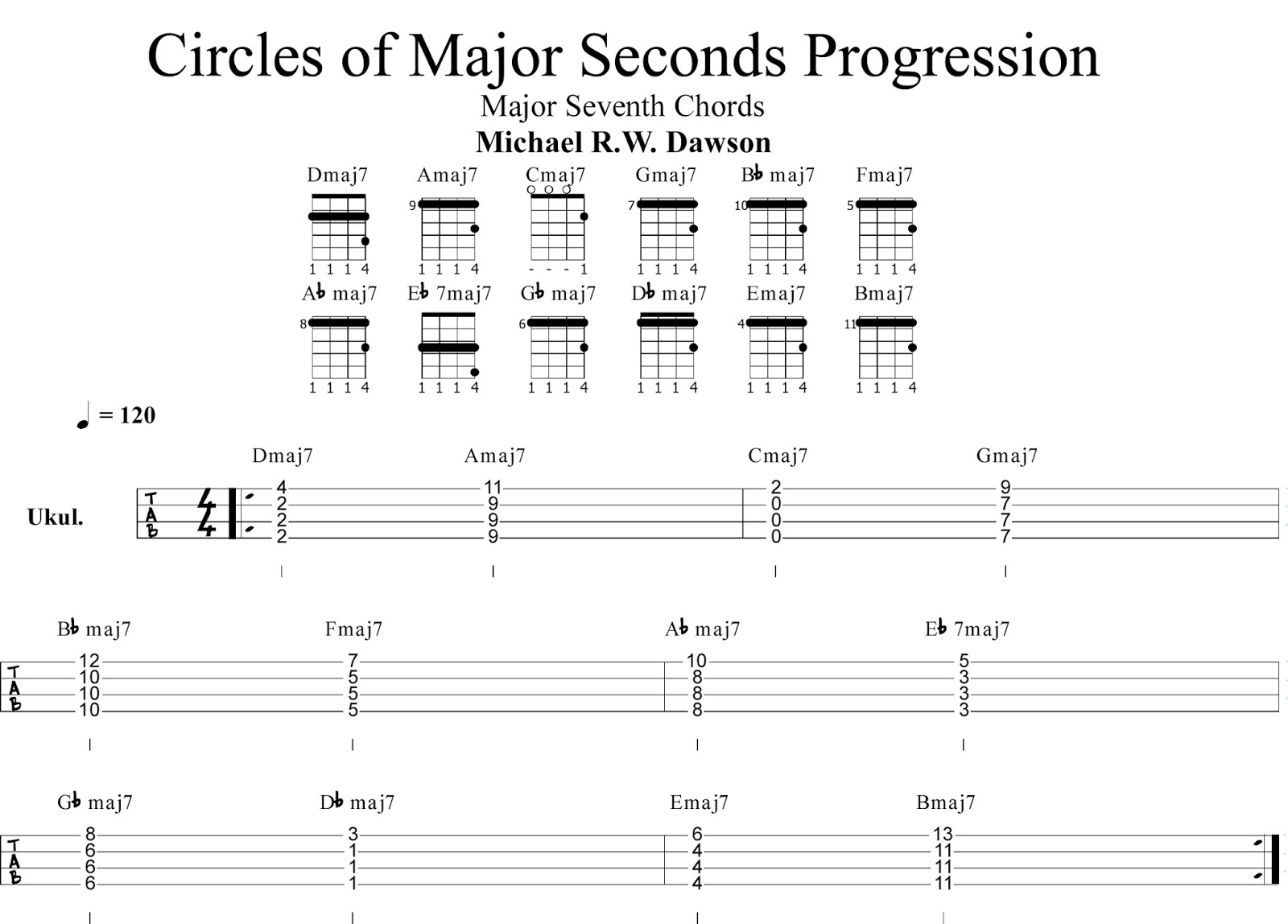

The score above offers just a hint of the potential for using the map.  Simple variations of the score involve replacing the major seventh chords with some other closed forms, such as the minor seventh (or major sixth), the dominant seventh, or the major.  Of course, one could then use different chord types at different points in the score.

Another approach to varying the sound of the progression would be to follow a different route on the map – for instance going from the inner ring to the outer ring for the first pair of chords, but then going from the outer ring to the inner ring for the following pair of chords.

Another interesting approach would be to follow the same paths that are illustrated above, but to rotate the inner ring to a different position inside the outer one.  For example, one clockwise twist of the inner ring would line up the D with the B, the C with the A, and so on.  Changing the position of the inner ring would change the musical distance between successive chords, and as a result change the musicality of the progression.

Saturday, May 16, 2015

Coltrane Changes on the Ukulele

As described in this previous post, the  text below is a draft of one of several "interludes" to be included in a book that I am working on concerned with music and artificial neural networks.


Figure I-14. The most basic ukulele chords for the ii-V-I progression in the key of C major.  See text for details.
 
When investigating musical problems with artificial neural networks, I find it useful to hear the stimuli on a musical instrument.  While I have spent a lot time working out stimulus patterns on the keyboard of my piano, these days my instrument of choice is the ukulele.  In this interlude I will provide the chords that I use to play the Coltrane changes in the key of C major, developing this chord structure from variations of the ii-V-I progression.
 
Figure I-14 provides the three chords that define the simplest version of the ii-V-I progression on the ukulele.  Each chord diagram illustrates the four strings of the ukulele, and the dots on the diagram indicate the fret at which each particular string is depressed.  The three chords that are presented are based on the assumption that the progression involves a sequence of three triads (D minor, G major, and C major).  That is, if one creates these three triads using only the notes available in the C major scale, then one of these chords is necessarily minor, while the other two are major (see the discussion of Figure 7-15).
 
The ii-V-I progression is a staple in jazz, and using triads doesn’t provide the jazziest sound.  Jazz musicians are more likely to extend the triads used to create the Figure I-14 chords to create tetrachords.  This extension, which involves adding an additional note to each chord from the C major scale, was also illustrated earlier in Figure 7-15.  Figure I-15 illustrates how one would play the C major tetrachords for the ii-V-I on the ukulele.  Note that the D minor has now become a D minor seventh, the G major has become a G dominant seventh, and the C major has become a C major seventh.
 
Figure I-15. The ukulele tetrachords for the ii-V-I progression in the key of C major.  See text for details.
 
All of the chords illustrated in Figures I-14 and I-15 are called open position chords.  This is because at least one ukulele string in the chord is open; that is, it is not pressed down by a finger.  The advantage of open position chords is that they generally are easier to play.  The disadvantage of such chords is that they are special in the sense that they cannot be moved up or down along the ukulele fret board to play the same type of chord in a different key.  This makes these chords different from the closed form chords that were the topic of the previous interlude “Ukulele Chords and Perceptrons”.  Our next move is to transform the Figure I-15 progression into one that uses closed position chords.
 
In order to perform this transformation, we will use two different tricks.  The first is to replace the Dm7 and Cmaj7 chords with alternative fingerings that can be found in a decent ukulele chord book (Johnson, 2005).  For these two chords we pick two fingerings that are related; both are barre chords that involve pressing the index finger down across all the strings at the fifth fret.
 
The second trick is to take advantage of chord substitution.  In general, jazz musicians see a chord’s name as an indicator of potential chords.  For instance, when such a musician sees that a G7 is the next chord, they would feel perfectly comfortable with substituting a different, but related, chord.  Chord substitution conventions permit G7 to be replaced, for example, with G9 or with G13 in order to add musical variety.  We will choose the G9 chord because the barre form of this chord places it in a similar position on the fret board to the other closed form chords in the ii-V-I, as is illustrated in Figure I-16.
 
Figure I-16. Closed form ukulele chords for the ii-V-I progression in the key of C major.  See text for details.
 
There are three important points to make about Figure I-16.  First, the particular chord choices that it illustrates begin quite a bit further down the fret board (at either fret 5 or 4) than was the case in Figures I-14 or I-16.  Each chord diagram has a number on the left indicating the starting fret, and the chord diagrams have been extended more than is typical to show where on the ukulele each chord is being played.
 
Second, the G9 chord that is illustrated is not likely to be found in many ukulele chord dictionaries.  This is because this form of the chord does not include the root note G.  Instead, it uses the other four pitches that are part of G9.  These four pitches actually define a minor seventh (flat fifth) chord in a different key.  G9 as illustrated in Figure I-16 is also Bm75.
 
Third, because these three chords are all in closed form one can move these patterns up or down the fret board to play the ii-V-I progression in a different key.  For instance if one uses the same chord patterns illustrated in Figure I-16, but moves each upwards a fret (towards the top of the page), then the result is the ii-V-I progression in the key of B major.
 
As detailed in Chapter 9, the Coltrane changes elaborate the ii-V-I progression by using the same three chords in Figure I-16, but also adds four additional chords that serve as lead ins.  We can create the Coltrane changes by adding these four chords to Figure I-16, attempting to choose closed form chords that minimize movements along the fret board.
 
The Coltrane changes for the ukulele in key of C major are presented in Figure I-17.  Each chord is a barre chord, meaning that this figure defines chord patterns that can be shifted to different fret board positions to generate the Coltrane changes in a different key.  For example, shifting each chord a fret downwards (towards the bottom of the page) produces this progression in the key of C# major.
 
 
Figure I-17.  Closed form ukulele chords for the Coltrane changes in the key of C major.
 
Creating the chord patterns in Figure I-17 serves the primary purpose of permitting me to play the Coltrane changes on the ukulele.  However, this set of chord diagrams suggests other uses.  One of the themes in Chapter 9 was exploring different encodings of jazz progressions for networks.  One could imagine adapting the encoding developed in the interlude that preceded Chapter 9 to present the jazz progressions to networks as sequences of ukulele chords.  What effect might this representation have on network complexity?

Similarly, Figure I-17 raises the possibility of generating alternative versions of the Coltrane changes for ukulele.  For instance, might easier chord fingerings emerge if one explores chord substitutions for the other dominant seventh chords in the figure?
 
References