Showing posts with label #abpse. Show all posts

Sunday, March 23, 2014

Postsecondary Perspective On A Premier’s Problems

Alberta Premier Alison Redford has suddenly resigned; her successor Dave Hancock was sworn in today.  Redford’s resignation was the culmination of several weeks of revolt within the Progressive Conservative party and the government caucus, daily reports of concerns about the premier’s travel expenses, and terrible poll results.  Many detailed analyses of how this whole situation arose, and what it means for the future of the PC party, are appearing in local and national newspapers.  These include an analysis by Professor Ted Morton (who offers a unique perspective given his role in ousting Redford’s predecessor, Premier Ed Stelmach), rumours of a within-government smear campaign, concerns about political misogyny,  and chalking it up to business-as-usual in a province where the governing party (and not the electorate) decides who should be premier.

Most of these analyses focus on factors within the governing party.  As it embarks on the process of finding a new leader and premier, I would like to point out an obvious fact about the premier’s and the party’s low popularity.  I focus on just one aspect of the government’s mandate, postsecondary education.  Similar points could be easily made using many other government policies.

The fact is this: during the 2012 provincial election, Redford campaigned on a particular platform; she delivered policies contrary to her platform in her March 2013 budget.

To illustrate, Redford’s campaign promises to reinvest in postsecondary education, and to provide stable and predictable funding for this sector, transformed into an over 7% budget cut that took university and college administrators by surprise.  Decisions of this type – about faces on campaign promises – have not surprisingly led to enormous decreases in the government’s popularity, not to mention the obliteration of the electorate’s trust of the government.

The many analyses of the current situation in Alberta politics examine dynamics within the government and the governing party, providing possible explanations for the tension between campaign promises and current policies.  It is important to remember, though, that the general electorate that is outside the party is perhaps less interested in explaining this tension, and is simply more interested in the fact that it exists!

Consider an earlier provincial election campaign successfully conducted by the same party, Ralph Klein’s 1993 “Miracle on the Prairie”.  Klein campaigned on a platform that promised harsh cutbacks in government spending, cuts that were likely more far reaching than those delivered by Redford’s 2013 budget.  Klein won a majority (as did Redford), and proceeded with various budget cuts (as did Redford), but Klein’s popularity went up when his fiscal plan was enacted.

The difference, of course, is that Klein delivered what he promised on the campaign trail.  Redford did not.
 

Wednesday, November 20, 2013

Santiago: Freedom To Read

I have just returned from a visit to Universidad Diego Portales (UDP) in Santiago, Chile.  I was hosted there by the Centro de Estudios de la Argumentación y el Razonamiento (CEAR), which is part of La Facultad de Psicología.  It was a fabulous trip, my first to South America, and my hosts were exceedingly kind.

As part of my visit, I presented a couple of public lectures on embodied cognitive science.  Prior to my first talk, Arturo Pérez, who had stayed with my wife and I in Edmonton last year, working on an interesting robotics project in my lab, led me on a walking tour of the beautiful UDP neighborhood.  There are many striking buildings in the area, including UDP’s Casa Central:

One stop on the tour was particularly poignant, and provided perspective on our current troubles in the Alberta postsecondary sector.  Arturo took me into a fairly new building, UDP’s Biblioteca Central.  At first glance, as can be seen below, it looks like many a North American library: books on display on the main floor, and stacks of books visible as one looks up from the entrance:


A closer examination of the books on display in the black shelves in the lobby is more chilling.  They were all banned by Augusto Pinochet after his military coup overthrew the government of Salvador Allende in 1973.  Along a wall to the left of this display is a long line of black and white photographs:

Each photograph is a picture of Pinochet’s soldiers in the process of burning books; here is just one example of the many photographs on display:

The books being burned were deemed subversive, including leftist literature and any other material inconsistent with the junta’s political position, including newspapers and magazines.  Arturo told me, as an example, that the ban included classic work in psychology by Russian scholars like Vygotsky.  In addition to being burned, these books were removed from the shelves of libraries and book stores.  The book bans lasted throughout the Pinochet regime, and book burnings sporadically continued.  In 1987 the Los Angeles Times reported that the Pinochet government burned thousands of copies of a book by Nobel prize winning author Gabriel Garcia Marquez.

As one comes to the end of this display, there is a particularly striking juxtaposition of images.  On the right is a colorful poster, America Despierta,, created by Patricia Israel and Alberto Pérez in 1972.  It is a colorful, stylized, political map of South America; it creates the shape of the continent using images related to its various countries.  For instance, Chile is in part depicted by its national flower (the copihue), miners, and one of its founders, Manuel Rodríguez.

Immediately to left of this poster is a photograph of it being burned in 1973:

The entire display of banned and burned books was profoundly sobering.  I was deeply moved, not in the least because of the display’s setting, surrounded by a huge number of books in a modern, thriving university library in central Santiago.  It was as if the books on the floors towering above me had risen from the ashes of those burned books on display below.

Of course, all of this made me reflect on my own experiences in Canada.  I have never encountered the violent oppression of ideas that was on display before me.  I was astonished at how much I took for granted my freedom to write, to read, and to think.

Surprisingly, though, I did not conclude that I should be content with my current situation in an Albertan postsecondary institution, because – as shown in those stark black and white photographs – things could be far worse than I could even imagine.  Instead, I realized that the tension between government policy and freedom to think is universal.  The current ‘push back’ that we are experiencing from the Alberta government seems (in comparison to Chilean history) fairly benign, in the sense that the only lever being used is financial.

However, it struck me that this is really a difference of degree, not of kind.  Restricting the opportunities of students to choose some programs of study relative to others (e.g. via preferential funding, reducing grants that lead to closed programs, creating institutes that explore some research domains and not others) reduces the freedom of our next generation to read, to think, and to choose, for themselves.

Saturday, October 19, 2013

A Deep Breath, Democracy, and Twitter Blocks

Thomas Lukaszuk, Deputy Premier  of Alberta and Minister of Enterprise and Advanced Education, has a very active Twitter account (@LukaszukMLA) – 8923 tweets and counting as of today.  Apparently this account has been in existence for less than two years.  It is commendable that he is taking advantage of social media, though I must admit that I am often bemused by the disconnect between the flow of information that he provides (via the #abpse hashtag) and that provided by others participating in the same dialogue.

Recently a number of Twitter users have reported that their accounts have been blocked by the Minister’s.  There is obvious anger about the Minister’s blocking, frequently expressed in conjunction with alarm about the state of democracy in Alberta.  The image below gives some sense of the situation.


My opinion? Everyone should take a deep breath, exhale slowly, step back, and consider things a bit more objectively and calmly.

First, I find it a bit of a stretch to consider that direct access to a politician via an unblocked Twitter account is a cornerstone of democracy.  Hopefully political dialogue requires more depth than is available in missives that can be no longer than 140 characters, and on average contain only 11 words!  And presumably democracy has been around a lot longer than Twitter, which was created in March of 2006.

Second, an objective examination of the tone of #abpse tweets over the past few months indicates a growing (and understandable) rancor.  There have been many negative tweets directed towards the Minister that have been personal in nature, and typically include his account name to appear directly in his Twitter feed.  I, for one, do not feel that this is particularly helpful or constructive, even though it conveys the emotions of the many affected by #abpse budget cuts.  If I was on the receiving end of this, then I would deal with it with whatever tools are available.  And, of course, account blocking is a perfectly reasonable tool to use in this case.  Sometime I’m surprised that the Minister’s account hasn’t disappeared completely!

Third, and related to the point above, if an open line of Twitter communication to the Minister is important, then perhaps we should consider the tone of our tweets before we share them.  I have no idea how many accounts he has blocked, I do not know who he has blocked, and I have no knowledge about the tweet content that results in being blocked.  If innocuous tweets lead to an account being blocked, then that would be unfortunate (but see below).  However, I am sure that the Minister’s account has seen a flood of tweets that were more than a little charged.  

Fourth, account blocking doesn’t prevent Twitter posts from being processed.  A blocked account cannot communicate with @LukaszukMLA directly, but can easily search for his tweets.  Similarly, I would be surprised if the Minister himself doesn’t search for #abpse tweets, seeing as he often uses that hashtag.  He can easily keep up with what he might be missing due to his blocking of some accounts.

Of course, keeping up with the public opinion expressed in Twitter is something that may be very important for the Minister to do.

In a recent column in The Guardian, John Naughton argues that Twitter provides a key technology for societies to discuss political issues, and suggests that recent debates by governments on either side of the Atlantic have been affected by electronically expressed public opinion.  Naughton’s column in The Guardian provides a link to an interesting paper from Carnegie Mellon University that shows that Twitter data is not only highly consistent with ‘gold standard’ public opinion surveys, but actually provides a leading indicator of survey results.  That is, Twitter analysis can ‘scoop’ the pollsters.  Apparently Twitter predicted not only the overall result of the latest provincial election in British Columbia, but also made accurate predictions about the seat distribution across all parties.  (It is not perfect, though.  Twitter analyses did not predict the results of the recent provincial election in Nova Scotia.)

In short, there are good reasons to keep #abpse tweets flowing, and they may provide important and accurate information to the Minister and his government regarding public opinion.  It is unfortunate that he has blocked some accounts.  But don’t worry about democracy: we still have it, and can exercise it at the ballot box during the next provincial election.

Friday, October 11, 2013

Engineering Photo-Ops

On October 9, the Premier of Alberta and the Deputy Premier (who is also minister of Enterprise and Advanced Education) visited the University of Calgary to make a major announcement: the government is contributing $142.5 million for U of C to expand its Schulich School of Engineering.  When the expansion is completed, there will be room for 400 additional engineering students.

On the one hand, this should be a ‘feel good’ story: this is a good result for that university, and it is good for the government to channel substantial funds back into the postsecondary system.  Accordingly, the government press release is filled with positive quotes.

On the other hand, Twitter exploded with many negative reactions (see figure below).  People were outraged that the government promise to U of C was nearly identical to the funding that it cut from postsecondary institutions in its spring budget.  There was a general outcry about favoritism: Calgary versus the other institutions in the province, engineering versus arts, and so on.  After all, the University of Alberta had just announced a mass departure of 121 employees, including 77 professors, due to a voluntary severance program that was instigated as a result of budget trouble.  Perhaps the optics of the announcement could have been better!


This is not to say that there was not a great deal of work creating positive photo opportunities at the announcement.  Pictures of dignitaries interacting with engineering students and their gadgets quickly appeared on social media.  I enjoyed the ‘thank you’ photograph that appeared on the Flickr feed of the Premier’s office, which is reproduced below.  Unless it is typical for school children to be milling about the U of C grounds wearing colorful ‘Future Engineer’ T-shirts, this photo was definitely … engineered!


I was particularly interested in the photograph of the Deputy Premier looking at some LEGO NXT robots displayed by engineering students.  It seems that the skills required to design such machines are appropriate in our current context of enterprise and advanced education.


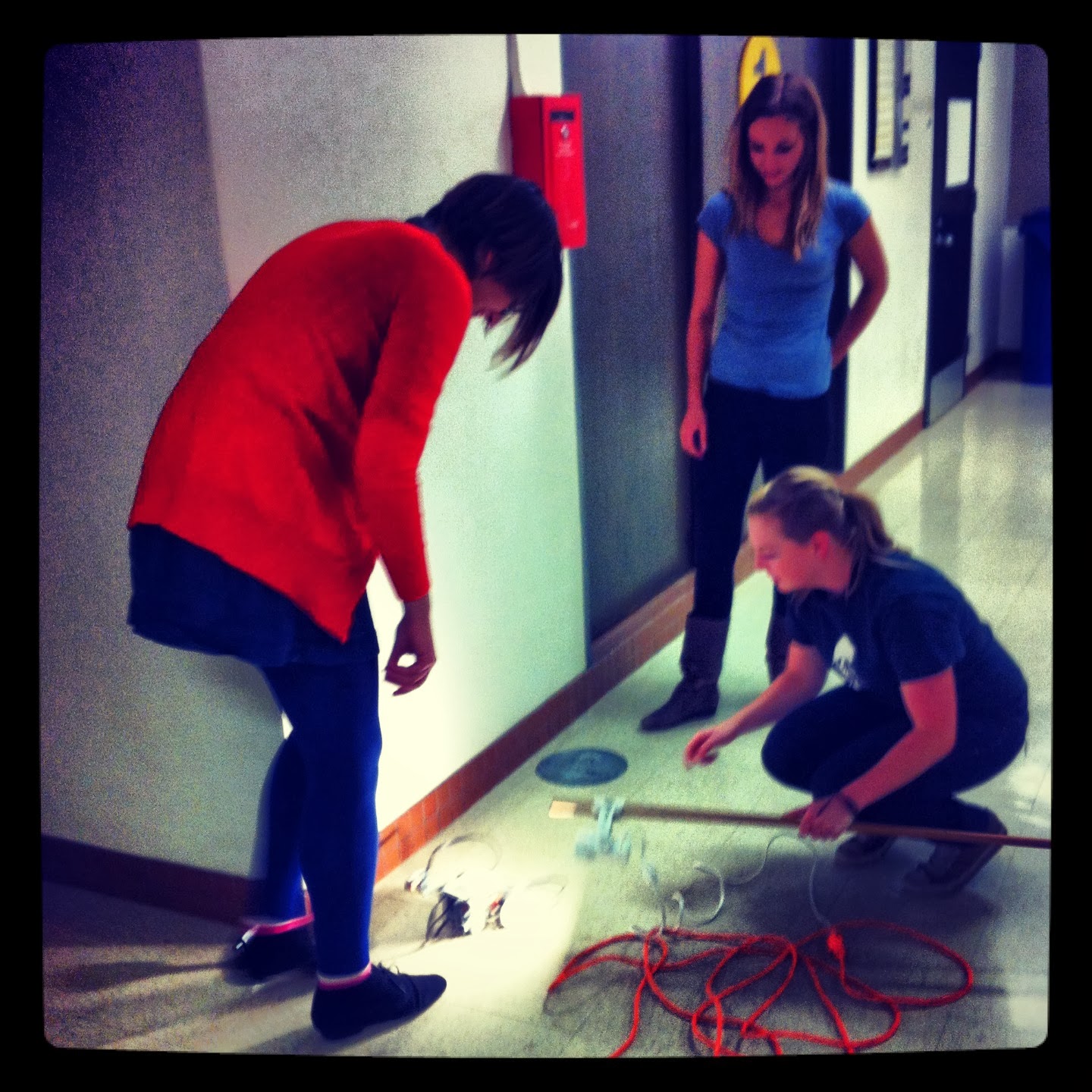
Why did I pay particular attention to this photograph?  Because the evening before it was taken, students in my PSYCO457 “Embodied Cognitive Science” course built their own robot, a Braitenberg Vehicle 2.  After constructing the robot, they observed its behavior and manipulated its design.  Next week they will alter the robot’s program to further their explorations.  Of course, I took advantage of all the activity to generate my own publicity shots.  The three photos below depict this year’s batch of students in the process of building,


the machine that they built (three were constructed),


and students experimenting with their creations.


Students in this course are typically psychology majors, some in the Faculty of Science and some in Arts.  (This year one is an English major, last year one was a Philosophy major).  The course’s current structure was developed a few years ago when I had the opportunity to meld my research with my teaching thanks to a McCalla Professorship that I was lucky enough to be awarded – from the Faculty of Arts.  A hint of why psychology students, arts majors, or philosophers can learn something from building robots is provided in a video that I made and posted on YouTube. (Yes, I know – a flagrant video-op!)  The last segment of that video is available here, and is most relevant to my point; other segments from that web page illustrate many robots designed by students for that course.

The irony in all of this – to get to the point of this blog entry – is that none of my students in this course are engineering majors.  If you look beyond the engineering buildings at any university you will be surprised at the diversity of skills and ideas that students are being exposed to!

 Photograph Sources

Source for ‘Thank You’ photo: Flickr feed, PremierOf Alberta’s photostream, http://www.flickr.com/photos/premierofalberta/10189141513/

Source for U of C LEGO robot photo: Twitter feed, Alberta Ministry of Enterprise and Advanced Education

My own photo-ops are occasionally posted on my Instagram feed drmrwdawson


Tuesday, October 01, 2013

On Voluntary Severance

The results of the University of Alberta’s Voluntary Severance Program were announced today.  This program offered money (up to twelve months salary) as an incentive for employees to leave the university.  Today it was announced that 121 staff members -- 83 Faculty, Faculty Service Officers, and Librarians, and 38 Administrative Professional Officers – were approved for leaving under the terms of this program.

This has to be one of the darkest days in the University’s history.

A closer examination of the details underlying this news is even more depressing.  My own faculty, Arts, is the worst hit with 30 losses.  A huge amount of experience – in the form of 53 full professors – is leaving the university.  This is expertise that will be nearly impossible to replace, even when the university is in the financial position to do so.

This was a point that I made last April (The Best, the Brightest, and the Alberta Budget).  I argued that the government was mistaken in its belief that it could attract and retain the best and brightest in a climate of reduced funding and of salary restraint.  That earlier blog quoted the Minister of Enterprise and Advanced Education’s belief that all was well:  “I would be very surprised if any professors are actually seriously thinking of leaving any university in Alberta”.

The news today – only five months after Minister Lukaszuk’s quote above – clearly shows that he was seriously mistaken.  Today one university has lost, in my view, a distressingly large number of staff, including a surprisingly large number of faculty members.

It is particularly disheartening and disturbing to see that 31% of these faculty losses (24 positions) were junior faculty members (assistant or associate professors).  These are individuals who have very productive career years ahead of them.  I wonder how many of these individuals are moving on to positions in other universities that are outside of Alberta. 
 
Their departure is a clear sign that things are going from bad to worse in Alberta’s postsecondary system.  Their voluntary severance needs to be interpreted as an alarming indicator about the poor state of Albertan universities.  It will certainly viewed as such by anyone outside of the province considering studying or working at one of these institutions.
 

Sunday, September 29, 2013

MIT Alberta?

Late last week, the Minister of Enterprise and Advanced Education for the Government of Alberta announced the members of a panel whose task is organizing a new “Institute for applied research and commercialization”, an institute that the government believes will be crucial for diversifying the Albertan economy.  The panel consists of 10 international experts, all of whom are experienced in similar agencies across the globe as well as with the Albertan context, according to a story in the Edmonton Journal.  The panel is chaired by the Massachusetts Institute of Technology’s Dr. Daniel Roos, who is their Japan Steel Industry Professor of Engineering Systems and Civil and Environmental Engineering.  According to the Edmonton Journal, for the past 18 months Dr. Roos has been involved with the University of Alberta on a related issue, and has written a report.  Thus the committee is, according to the Minister, expected to hit the ground running and will deliver a set of recommendations about how to proceed with the new institute in a matter of weeks.

Dr. Roos’ experience with “similar agencies across the globe” comes from his being director of the MIT Portugal Program.  According to its website, MIT Portugal “is an international collaboration seeking to demonstrate that an investment in science, technology and higher education can have a positive, lasting impact on the economy by addressing key societal issues through quality education and research in the emerging field of engineering systems.”  It is probably much too early to do so – the organizing panel hasn’t even met – but I thought that I would take a while browsing through the MIT Portugal website to see a glimmer of what might be on the horizon here in Alberta.

MIT Portugal, focused exclusively on engineering, involves four entities: the government of Portugal, seven Portuguese universities and 14 Portuguese research centers, industry, and MIT.  MIT Portugal targets four areas that are viewed as keys to economic development and societal impact: sustainable energy systems, transportation systems, bio-engineering systems and advanced manufacturing.  It began in October 2006; “government funding to MIT and partner Portuguese institutions supports this unique collaboration.”  I have been unable to find on the MIT Portugal website any mention of how much government funding is involved, how much industry funding is involved, and the like.  There are a number of attractive publications about its research activities.

MIT Portugal only offers three kinds of graduate degrees:  PhDs, Master’s, and Executive Master’s.  It is not involved in undergraduate training.  It views as one of its key accomplishments is “developing highly skilled human resources in the scientific and technological community in Portugal.”  On more than one page of its website one can find numbers related to how many graduate students have been trained since MIT Portugal’s creation. Financial numbers, however, are not easily found on the website.  Dollar values related to MIT Portugal’s expenditures, or to the economic impact of its research, or to industry contributions to its programs, do not appear to be publicly available.  Perhaps someone else will have better luck searching for them than I did.

One wonders if MIT Portugal will provide a model for the new Albertan institute.  If so, we would expect that it would have these general properties: it would use existing infrastructure (current Albertan universities and labs), it would add a new administrative component (to organize its courses, degrees, etc.), it would focus on a small number of areas predicted to be high reward, and it would only train graduate students.  Of course, it would also require specialized government funding (e.g. grant support to foster research in targeted areas).  Would it also require funding to obtain external expertise as leverage to diversify the provincial economy?  Is MIT Alberta on the horzion?  Presumably we will have a much better idea of the structure and costs of this new institute, and how its funding will affect the funding of other postsecondary schools in Alberta, in a matter of weeks after the new panel presents its recommendations.


Monday, September 23, 2013

The State Of The University

Last Thursday, University of Alberta President Indira Samarasekera delivered a state of the university address, her first since the provincial government surprisingly cut university funding in its spring budget.  She called for the university community to be open to change.  She outlined a four point action plan for dealing with the university’s current challenges: academic transformation; a balanced, sustainable and flexible funding model; efficient administration; and a university culture change.

This plan aims to weather the current financial storm with a particular goal in mind: “to preserve and enhance the University of Alberta’s core mission of delivering excellence in teaching, research, and service supported by sustainable, balanced financial models.”  The President’s vision, supported by Doug Goss, chairman of the board of governors, remains making the University of Alberta one of the world’s great public universities.  In answer to one question from the audience, Samarasekera noted that “we cannot cut our way to greatness.”

The speech stimulated both an article and an editorial in the Edmonton Journal. The editorial viewed the speech as a skillful handling of the diverse pressures that Samarasekera faces. The article described the speech as “upbeat” and a restatement of the goal of making the University of Alberta a “top-tier school.”  Some who watched the speech ‘live tweeted’ fragments of it; these typically were quotes about maintaining or enhancing the university’s excellence.  This message certainly resonated with the university community.

Other recent developments also affirm higher administration’s goals concerning university excellence.  For instance, less than a week before the state of the university address, President Samarasekera announced the Peter Lougheed Leadership Initiative in cooperation with the Banff Centre. It intends to be “one of the pre-eminent leadership development programs in the world.”  This initiative is currently in the planning stages, and may eventually involve a building with residences.  A fundraising goal of $60 million has already been set.

As part of her state of the university address, President Samarasekera drew inspiration from the history of the construction of the Arts Building in which she presented her speech.  The first president of the university, Henry Marshall Tory, intended it to be the first major teaching building on campus.  The sod turning ceremony for the Arts Building was held in 1909.  After the foundation was poured, planning conflicts and vagaries of provincial funding led to a halt in construction.  Samarasekera noted that “it all added up to a hole in the middle of campus that collected water each spring for four years.”  Funding and support was not secured until 1913, leading to continued construction – but construction halted again, before a roof was added to the building, when funding ran out.  Tory apparently convinced the contractors to complete the building and to be paid for their efforts later.  “And thus the building was finally completed and from that point onward became the heart of campus.”

What is the moral of the history of the Arts Building?  For our current president, “this building and its story reminds me that persistence and resilience are as hardwired into the U of A’s culture as excellence and ambition.”  Towards the end of her speech, she again cited Henry Marshall Tory’s persistence and resilience, which he demonstrated were fundamental to the creation of excellence.

This is certainly an upbeat message, and one worthy of taking to heart.  However, Tory taught us other lessons as well.

For instance, the halt in construction of the Arts Building did not mean that other buildings were not being created on the new university’s campus.  Alberta College South (now St. Stephen’s College) and Athabasca Hall were both in existence when the university moved from temporary quarters to its current location in 1911.  University growth at this time led to an expansion of Athabasca Hall and the planning of Assiniboia Hall, whose construction was completed in 1912 – three years before the Arts Building was opened.

In other words, the hole in the ground collecting water for four years also symbolized Tory’s willingness to patiently delay some plans while working to meet other basic needs of the university. (By 1912 Athabasca Hall had had its dining hall and kitchen enlarged.  This was done to meet the demands of 80 additional residents.)

As difficult budgetary decisions are made in the coming weeks at the University of Alberta, it is certainly important to be inspired by Tory’s persistence and resilience.  However, it may be just as important to keep in mind his patient practicality.  What university needs must be met in the short term?  What worthy goals may have to be delayed while the university faces its current challenges?  Hopefully answers to questions like these will emerge soon from the many discussions initiated on campus since the provincial budget was delivered last March.


Tuesday, September 03, 2013

#abpse

A number of postsecondary instructors – including myself -- will begin the new fall term by informing their students about the existence of a particular Twitter hashtag, #abpse. This blog entry provides some context for the conversation that is developing around the #abpse thread.

In the 2012 Alberta provincial election campaign, the Progressive Conservative party expressed strong support for post-secondary education.  Announcing a $650 million promise for infrastructure funding, Premier Redford said "There's no doubt that post-secondary institutions in this province, no matter where they are, are the key to our future success.”  Post-secondary institutions were expecting stable three year cycles of funding in provincial budgets, and were also expecting a 2% increase in funding in the March 2013 budget.

The March 2013 budget, however, did not fulfill these expectations.  Instead, post-secondary funding was cut by 7.3%.  Over the last few months, post-secondary institutions across the province have been suspending some programs, placing limits on student admissions, and making other difficult decisions in order to deal with this change in provincial funding.  Some predict that the situation is going to get worse.  For instance, not too many days ago the Faculties of Arts and Science at the University of Alberta indicated that they needed to achieve cuts that, when combined, totaled over $12 million, and needed to do so by April, 2014.

The #abpse thread in Twitter is an important source of information about this entire situation.  The figure below, taken today from a Topsy feed that I created, indicates that over the past month there has been an average of over 230 tweets per day that include the #abpse hashtag.  There is clearly a tremendous amount of interest in this issue on Twitter.  The sharp rise in the middle of the figure corresponds to the announcements from Arts and from Science at U of A later in August.

 
The #abpse thread is important for a number of reasons.  First, it is a constant source of links to news articles related to the impact of the government’s post-secondary funding decisions.  Second, it is monitored – and contributed to – by the Minister of Enterprise and Advanced Education, Thomas Lukaszuk.  Third, it is contributed to by a wide variety of individuals – students, staff, and others – from across the province.

At times, the tone of these tweets is angry and combative, expressing (I think) the fact that these cuts are impacting individuals who are concerned about their livelihood, their program of study, or their view about the quality of post-secondary education in this province.  Many different opinions are expressed.  There are disagreements about how, and even whether, the cuts will affect students.  There are debates about the necessity of the cuts, as well as about how they should be implemented.  There are appeals to the government and to opposition parties about future policies and pleas to reverse the cuts.  There are questions about the relationship between enterprise and advanced education, as well as about the purpose of universities and university degrees. 

Students, explore Twitter’s #abpse hashtag.  Watch it, learn from it, become involved with it.

Thursday, August 22, 2013

Calling A Clean Pot Black

A few days ago Thomas Lukaszuk, Minister of Enterprise and Advanced Education, announced that private consultants were being called in to assist the University of Alberta in balancing its budget by 2014-2015.  Doug Goss, chair of the university’s board of governors, is confident that the financial management of the university will stand up to this external scrutiny.  Edmonton Journal columnist Paula Simons accuses the minister of micromanaging the University of Alberta’s decisions on how specifically it should spend its revenue.

I took a few moments to glance through some recent University of Alberta annual financial statements which are provided here.  Basically, I was interested in the difference between revenues and operating expenses.  My results are presented in the table below.  It shows that the University reported operating deficits (which occurred when expenses exceeded revenue) in only two years (2008 and 2009).  It should be noted that for accounting reasons these numbers do not include an accumulating debt related to maintenance costs.  As well, it does not include the University’s plan to operate with a deficit for the next three years as it implements a plan to balance its budget.  The minister is apparently unhappy with this three year plan, desires the university budget to be balanced earlier, and is spending $70,000 on external consultants to help achieve this goal.

Report Year
Revenue
Expenses
Revenue Minus Expenses
2006
$1,123.0
$1,124.5
$57.3
2007
$1,205.9
$1,191.9
$65.8
2008
$1,228.5
$1,327.4
-$42.0
2009
$1,344.4
$1,487.5
-$67.6
2010
$1,606.7
$1,593.2
$13.5
2011
$1,644.7
$1,569.6
$75.2
2012
$1,690.9
$1,679.1
$11.8
2013
$1,727.8
$1,702.4
$25.4
Revenue and expense information from recent financial statements available from the University of Alberta website.  All values are in millions of dollars.

  The two years of deficit reported in the table reflect the results of a worldwide financial crisis.  For instance, the University’s 2009 financial statement notes: “The 2009 deficiency is mainly due to investment losses.  The global economic crisis has continued to have an unfavorable impact on investment returns.”

The table suggests that the University was able to rebound from this unfavorable impact relatively quickly; its ability to adapt was due to its ability to find ‘administrative efficiencies’.  It is still doing so in light of the March budget’s surprise cut in postsecondary funding.  For example, the 2013 financial statement states: “The $25.4 million operating surplus is mainly due to savings at the unit level which have occurred as units reduce spending to assist in meeting their 2013-14 operating budget reductions.”  Given this kind of information, it is perhaps not too surprising that the chair of the board of governors is confident of the result of external scrutiny.
 
Of course, the provincial government has not been as successful in dealing with the financial upheaval of 2008.  As obvious in the image below, which the Calgary Herald included as part of a story on the 2013-14 provincial budget, 2008 marked the start of an unbroken string of provincial deficits.  A nice synopsis this string is provided in this story by CTV News.  The cost of recent flooding in the province will hardly help this situation. It seems to me that hiring the consultants is a case of an encrusted kettle calling a clean pot black.